Part 2: Exodus & Formation · c. 1200 BCE
7.Sinai and the Law
Hammurabi comparison, monotheism origins
21 min read
The Code of Hammurabi Verified
In December 1901, French archaeologists excavating the ancient Elamite capital of Susa (modern Shush, Iran) discovered one of the most important artifacts in human history: a seven-foot-tall black diorite stele inscribed with the law code of Hammurabi, King of Babylon (r. 1792–1750 BCE). The stele, now the centerpiece of the ancient Near Eastern collection at the Louvre in Paris (Sb 8), had been carried to Susa as war booty by the Elamite king Shutruk-Nahhunte in the 12th century BCE.
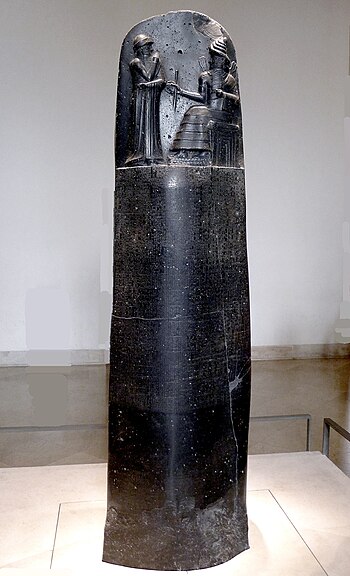
The top of the stele bears a carved relief showing Hammurabi standing before the seated sun god Shamash, the divine patron of justice, receiving (or presenting) the laws. Below, in 49 columns of cuneiform text, are approximately 282 legal provisions covering nearly every aspect of Babylonian life: property rights, commercial transactions, family law (marriage, divorce, inheritance, adoption), personal injury, slavery, agriculture, and professional liability.
The Code of Hammurabi was not the earliest law code in Mesopotamia. Earlier collections include the Laws of Ur-Nammu (c. 2100 BCE), the Laws of Lipit-Ishtar (c. 1930 BCE), and the Laws of Eshnunna (c. 1770 BCE). But Hammurabi's code is by far the most complete and best preserved, and its discovery opened a new chapter in the comparative study of biblical law.
The parallels between Hammurabi's Code and the legal collections in Exodus, Leviticus, and Deuteronomy are extensive and significant. Both address similar topics — personal injury, property damage, family law, slavery, agricultural disputes — and share specific formulations. The most famous parallel involves the lex talionis (law of retaliation):
Hammurabi, Law 196: "If a man has destroyed the eye of a member of the awilu-class, they shall destroy his eye."
Exodus 21:24: "Eye for eye, tooth for tooth, hand for hand, foot for foot."
The similarities extend to specific case law formulations. Both codes use casuistic ("if... then...") legal forms: "If an ox gores a man and kills him..." appears in both Hammurabi (Laws 250–252) and Exodus (21:28–32), with similar but not identical provisions for the owner's liability.
Biblical Law and Mesopotamian Law: Comparison Debated
The relationship between biblical and Mesopotamian law has been studied intensively since the discovery of the Hammurabi stele. Several key areas of comparison and contrast have emerged:
Legal form: Both traditions use two types of legal formulation: casuistic law ("If a man does X, then Y shall be done") and apodictic law ("You shall not murder"). Mesopotamian codes are almost entirely casuistic. Biblical law uniquely combines casuistic provisions (the "Covenant Code," Exodus 21–23) with apodictic commands (the Ten Commandments, the "Holiness Code" of Leviticus 19). The apodictic form — direct divine command in the second person — has no real parallel in Mesopotamian law and represents a distinctive Israelite contribution to legal tradition.
Source of authority: In Hammurabi's Code, the king is the source of law, inspired by the gods but acting on his own royal authority. In the biblical tradition, God is the direct lawgiver; Moses is merely the mediator. This distinction has profound consequences: in Mesopotamia, law is a function of royal power; in Israel, law is a function of divine covenant. No Israelite king had the authority to promulgate new law in his own name — a principle that set Israel apart from its neighbors and laid groundwork for the concept of a law above the ruler.
The value of life: Hammurabi's Code contains sharp class distinctions. Injuring a member of the awilu (upper) class carries harsher penalties than injuring a mushkenu (commoner) or a slave. Biblical law, while not entirely egalitarian (distinctions between Israelites and resident aliens, between free persons and slaves, do exist), is notably more uniform. The lex talionis applies regardless of social class — a revolutionary leveling principle. Moreover, biblical law never prescribes the death penalty for property crimes; Hammurabi's Code does (e.g., Law 6: death for theft of temple property; Law 22: death for robbery).
Slavery: Both systems regulate slavery, but with significant differences. Hammurabi's Code treats slaves as property with limited rights. Biblical law, while permitting slavery, imposes remarkable constraints: Hebrew slaves must be freed after six years (Exodus 21:2); a slave injured by the master goes free (Exodus 21:26–27); a fugitive slave must not be returned to the master (Deuteronomy 23:15–16) — a provision that directly contradicts the practice assumed in the Hammurabi Code and most ancient Near Eastern law.
Theological grounding: Perhaps the most fundamental difference is that biblical law is embedded within a narrative of redemption. The Covenant Code (Exodus 21–23) follows immediately after the Ten Commandments, which begin: "I am the LORD your God, who brought you out of Egypt, out of the land of slavery" (Exodus 20:2). The laws are not abstract principles but obligations arising from a specific relationship — God liberated Israel; therefore Israel must live in a particular way. This narrative-legal integration has no parallel in Mesopotamian tradition.
The Hittite Suzerainty Treaty and the Sinai Covenant Verified
The discovery of Hittite treaty documents at Hattusa (Bogazkoy, Turkey) in the early 20th century provided a second major comparative framework for understanding the Sinai covenant. As noted in Chapter 3, George Mendenhall (1954) and Klaus Baltzer (1960) identified striking parallels between the structure of Late Bronze Age Hittite suzerainty treaties and the Sinai covenant.
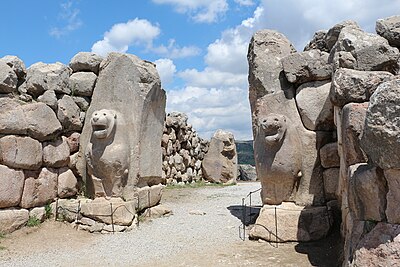
The Hittite treaty form, exemplified by treaties such as the Treaty of Suppiluliuma I and Huqqana of Hayasa (c. 1350 BCE) and the famous Treaty of Ramesses II and Hattusili III (1259 BCE, with copies found at both Hattusa and Karnak, and a version now displayed at the United Nations as the oldest known peace treaty), follows a consistent pattern:
- Preamble: "These are the words of [Great King], the Great King, King of Hatti..."
- Historical Prologue: Recounting the Great King's past benefits to the vassal
- Stipulations: The vassal's obligations (loyalty, military support, extradition of fugitives)
- Provision for deposit and reading: The treaty tablet placed in the temple, to be read periodically
- Divine witnesses: Gods of both parties invoked
- Blessings and curses: Consequences of observance and violation
The Sinai covenant, particularly as presented in Exodus 20 and expanded in Deuteronomy, follows this pattern remarkably closely:
- Preamble: "I am the LORD your God" (Exodus 20:2a)
- Historical Prologue: "who brought you out of Egypt, out of the land of slavery" (Exodus 20:2b)
- Stipulations: The Ten Commandments and the Covenant Code (Exodus 20:3–23:33)
- Deposit and reading: The tablets placed in the Ark; the law to be read every seven years (Deuteronomy 31:10–13)
- Witnesses: Heaven and earth are invoked (Deuteronomy 30:19); the song of Moses serves as a witness (Deuteronomy 31:19)
- Blessings and curses: Deuteronomy 27–28
This parallel has been both celebrated and criticized. Mendenhall and his followers argued that the Sinai covenant was directly modeled on Hittite treaties, pointing to an early (Late Bronze Age) date for the covenant tradition. Critics, including Dennis McCarthy and Moshe Weinfeld, noted that treaty forms evolved over time, and that some features of the biblical covenant (particularly in Deuteronomy) more closely resemble first-millennium Assyrian treaties (e.g., the vassal treaties of Esarhaddon, 672 BCE) than Hittite ones. The treaty parallels may indicate that the covenant concept developed over centuries, with different biblical texts reflecting different stages of ancient Near Eastern treaty tradition.
The Sinai Revelation Tradition
The revelation at Sinai (Exodus 19–24) is the theological climax of the Torah and one of the most dramatic scenes in all of scripture. Its significance for Judaism cannot be overstated: every subsequent commandment, interpretation, and rabbinic ruling is understood as flowing from this moment.
The narrative unfolds in stages:
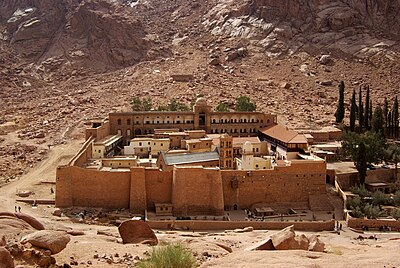
Preparation (Exodus 19): Three months after leaving Egypt, the Israelites arrive at Mount Sinai. God proposes a covenant: "If you obey me fully and keep my covenant, then out of all nations you will be my treasured possession... a kingdom of priests and a holy nation" (Exodus 19:5–6). The people respond unanimously: "Everything the LORD has said we will do" (19:8). Moses instructs them to consecrate themselves for three days. On the third day, "there was thunder and lightning, with a thick cloud over the mountain, and a very loud trumpet blast... Mount Sinai was covered with smoke, because the LORD descended on it in fire" (19:16, 18).
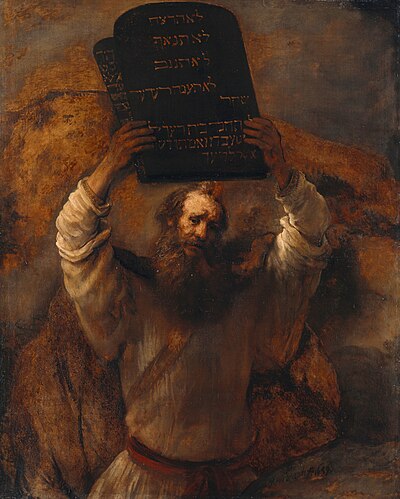
The Ten Commandments (Exodus 20:1–17): God speaks the Ten Commandments (Aseret ha-Dibrot, literally "Ten Utterances") directly to the assembled people. The commandments divide naturally into duties toward God (no other gods, no idols, no misuse of God's name, keep the Sabbath) and duties toward fellow humans (honor parents, no murder, no adultery, no theft, no false testimony, no coveting). This dual structure — vertical (God-human) and horizontal (human-human) — encapsulates the entire ethical system of the Torah.
The Covenant Code (Exodus 21–23): Following the Ten Commandments, Moses receives detailed legislation covering slavery, personal injury, property, social justice, religious festivals, and the conquest of Canaan. This collection, often called the "Book of the Covenant" (Exodus 24:7), is widely regarded as one of the oldest legal collections in the Bible.
The Covenant Ceremony (Exodus 24): Moses writes down all the Lord's words, builds an altar with twelve pillars (representing the twelve tribes), and sends young men to offer sacrifices. He reads the "Book of the Covenant" to the people, who respond: "Na'aseh v'nishma" — "We will do and we will hear/understand" (Exodus 24:7). Moses sprinkles sacrificial blood on the altar and on the people, declaring: "This is the blood of the covenant that the LORD has made with you."
The phrase na'aseh v'nishma — placing doing before understanding — became a central concept in Jewish theology. The Talmud (Shabbat 88a) records that when the Israelites said "we will do and we will hear," a heavenly voice proclaimed: "Who revealed to My children this secret that the ministering angels use?" The willingness to commit to observance before fully understanding the commandments is seen as the essence of faith and the foundational act of Jewish covenantal life.
The Ten Commandments: Text and Context Tradition
The Ten Commandments (Decalogue) appear twice in the Torah — in Exodus 20 and Deuteronomy 5 — with significant differences between the two versions that have occupied scholars and theologians for centuries.
The most notable difference concerns the Sabbath commandment:
Exodus 20:11: "For in six days the LORD made the heavens and the earth... therefore the LORD blessed the Sabbath day and made it holy." (Creation rationale)
Deuteronomy 5:15: "Remember that you were slaves in Egypt and that the LORD your God brought you out... Therefore the LORD your God has commanded you to observe the Sabbath day." (Exodus rationale)
The existence of two versions with different rationales illustrates a key principle of biblical interpretation: the Torah contains multiple voices and perspectives, unified by overarching theological commitments but not by rigid uniformity.
The numbering of the commandments itself varies among traditions. Jews, Catholics, and Protestants divide the ten differently:
- Jewish tradition: "I am the LORD your God..." is the first commandment (a statement of identity rather than a prohibition); "You shall have no other gods..." and "You shall not make for yourself an idol..." together constitute the second.
- Protestant tradition: "You shall have no other gods" and "no idols" are separated as commandments one and two.
- Catholic/Lutheran tradition: "No other gods" and "no idols" are combined as one; "no coveting" is split into two (coveting neighbor's wife; coveting neighbor's goods).
The Tabernacle: A Portable Temple Tradition
Exodus 25–31 and 35–40 describe in extraordinary detail the construction of the Mishkan (Tabernacle) — the portable sanctuary that served as God's dwelling place among the Israelites during their wilderness wanderings and into the early period in Canaan.
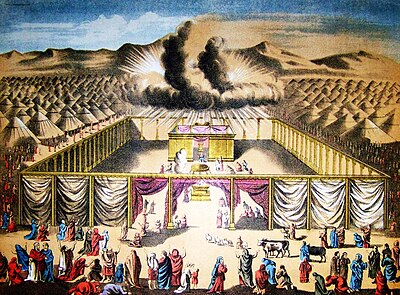
The Tabernacle consisted of an outer courtyard (100 x 50 cubits, approximately 150 x 75 feet) enclosed by linen curtains, containing a bronze altar for sacrifices and a bronze laver for priestly washing. Within the courtyard stood the tent itself, divided into two chambers: the Kodesh (Holy Place), containing the golden lampstand (menorah), the table of showbread, and the incense altar; and the Kodesh ha-Kodashim (Holy of Holies), containing the Ark of the Covenant (Aron ha-Brit) — a gold-covered wooden chest surmounted by two golden cherubim, within which were placed the tablets of the Ten Commandments.
The Tabernacle's design has been compared to Egyptian and Canaanite portable shrine traditions. Egyptian military camps in the Ramesside period included portable tent-shrines for divine images, depicted in reliefs at Abu Simbel and Medinet Habu. The prefabricated, demountable structure described in Exodus — with its acacia wood frames, linen coverings, and gold fittings — is consistent with what we know of ancient Near Eastern portable sanctuaries, though no direct parallel of the same scale has been found.
Scholar Michael Homan (To Your Tents, O Israel!, 2002) has argued that the Tabernacle's dimensions and structure closely parallel the Egyptian military tent of Ramesses II, depicted in the Battle of Kadesh reliefs at Abu Simbel, Luxor, and the Ramesseum. If correct, this parallel would place the Tabernacle tradition in the context of the Ramesside period — consistent with the late Exodus date.
The theological significance of the Tabernacle is profound. It represents God's willingness to dwell (shakan, from which Mishkan derives) among the people — a concept that would develop into the rabbinic notion of the Shekhinah, God's indwelling presence. The elaborate instructions for its construction occupy more text in Exodus than any other subject, including the Ten Commandments — a reminder that for the biblical authors, the details of worship were not secondary to the details of ethics.
Monotheism: When Did It Begin? Debated
The Sinai revelation is traditionally understood as the moment when God established monotheism as the foundation of Israelite religion. But the history of Israelite monotheism is far more complex than this straightforward narrative suggests.
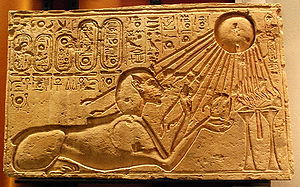
The Akhenaten Comparison: Pharaoh Akhenaten (r. 1353–1336 BCE) famously promoted the worship of the Aten (the solar disk) above all other gods, closing temples and redirecting resources to the Aten cult. His "Great Hymn to the Aten" (found in the tomb of Ay at Amarna) bears remarkable similarities to Psalm 104. Was Akhenaten a monotheist? Scholars debate whether his theology was true monotheism (denial of other gods' existence) or monolatry (worship of one god without denying others). In either case, the Aten revolution was short-lived: after Akhenaten's death, his successor Tutankhamun restored traditional polytheism.
The chronological proximity of Akhenaten to the proposed Exodus date has led some scholars (notably Jan Assmann in Moses the Egyptian, 1997) to explore connections between Atenism and Mosaic monotheism. However, no direct historical link has been established, and the theological content of the two systems differs fundamentally: Atenism focused on a cosmic natural force (the sun); Yahwism centered on a personal God who acts in history.
The Evolution of Israelite Religion: Modern scholarship recognizes that the monotheism of the Hebrew Bible as we have it — the absolute insistence that YHWH alone is God and all other gods are nonexistent — represents the endpoint of a long development, not its starting point. Several stages can be identified:
-
Polytheism: The earliest Israelites likely worshipped multiple deities, as their Canaanite neighbors did. Archaeological evidence includes the 8th-century BCE inscriptions from Kuntillet 'Ajrud in the Sinai, which refer to "YHWH and his Asherah" — suggesting that at least some Israelites worshipped YHWH alongside a female consort deity. Similar inscriptions from Khirbet el-Qom near Hebron reinforce this picture.
-
Monolatry: The earliest biblical texts may reflect not monotheism but monolatry — exclusive devotion to YHWH without denying the existence of other gods. Exodus 15:11 ("Who among the gods is like you, LORD?") and Psalm 82 ("God presides in the great assembly; he renders judgment among the gods") assume the existence of other divine beings while affirming YHWH's supremacy.
-
Monotheism proper: The explicit denial of other gods' existence appears most clearly in Second Isaiah (Isaiah 40–55), dating to the Babylonian Exile (6th century BCE): "I am the LORD, and there is no other; apart from me there is no God" (Isaiah 45:5). The Shema — "Hear, O Israel: the LORD our God, the LORD is one" (Deuteronomy 6:4) — is sometimes translated as a monotheistic statement ("the LORD is one") and sometimes as a monolatric one ("the LORD is our God, the LORD alone").
The Kuntillet 'Ajrud Inscriptions: Discovered in 1975–76 at a remote site in the northeastern Sinai, these 8th-century BCE inscriptions on plaster and storage jars include blessings by "YHWH of Samaria and his Asherah" and "YHWH of Teman and his Asherah." The accompanying drawings include a possible depiction of YHWH and Asherah, though the identification of the figures is debated. These inscriptions, now in the Israel Museum, Jerusalem, provide the most direct evidence that popular Israelite religion in the 8th century BCE included goddess worship alongside YHWH.
The Documentary Hypothesis and the Torah's Composition Debated
The question of who wrote the Torah — and when — is inseparable from the question of the Sinai revelation. Jewish tradition holds that God revealed the entire Torah to Moses at Sinai (with the possible exception of the last eight verses describing Moses' death, per Talmud Bava Batra 15a). Critical scholarship, since the 17th century, has proposed alternative models.
The Classic Documentary Hypothesis (Wellhausen, 1878): Julius Wellhausen, building on the work of predecessors including Jean Astruc (1753), W.M.L. de Wette (1805), and Karl Heinrich Graf (1866), proposed that the Torah was composed from four main source documents, compiled by a final redactor (R):
-
J (Jahwist/Yahwist): Written c. 950 BCE in Judah. Uses the divine name YHWH from the beginning. Anthropomorphic portrayal of God. Narrative-focused, earthy, vivid. Associated with the southern kingdom.
-
E (Elohist): Written c. 850 BCE in Israel (northern kingdom). Uses Elohim for God until the name YHWH is revealed at Sinai. God communicates through dreams and angels rather than direct contact. Associated with prophetic traditions.
-
D (Deuteronomist): The core of Deuteronomy, associated with the law book "discovered" in the Temple during Josiah's reforms (622 BCE, 2 Kings 22–23). Emphasizes centralization of worship in Jerusalem, covenant theology, and the blessings-and-curses framework.
-
P (Priestly): Written during or after the Exile (6th–5th centuries BCE). Systematic, liturgical, concerned with genealogies, dates, measurements, and ritual purity. Responsible for Genesis 1, the Tabernacle descriptions, Leviticus, and the genealogical frameworks.
Challenges and Revisions: The Documentary Hypothesis has been extensively modified since Wellhausen's time. Major challenges include:
-
Rolf Rendtorff and Erhard Blum (1970s–80s) proposed that the Torah grew not from continuous documents but from originally independent tradition blocks (creation, patriarchs, exodus, Sinai, wilderness, conquest) that were gradually compiled.
-
John Van Seters argued that J was not early (10th century) but late (exilic), written as a prologue to the Deuteronomistic History.
-
The "Neo-Documentary" approach (Joel Baden, Jeffrey Stackert) has revived a modified form of the classic hypothesis, arguing that four relatively coherent source documents can still be identified, though with revised dating.
-
The "Supplementary Hypothesis" argues that the Torah grew through successive supplements to a core text rather than through the combination of parallel documents.
Despite these disagreements, several points command broad scholarly consensus: (1) the Torah as we have it is a composite work, not the product of a single author; (2) it contains material from different periods, ranging from possibly early (the Song of the Sea, some legal traditions) to demonstrably late (the Priestly genealogies, much of Deuteronomy); (3) the final form of the Torah was achieved during or after the Babylonian Exile (6th–5th centuries BCE).
The Sinai Covenant in Jewish Tradition Tradition
For Judaism, the Sinai revelation is not merely a historical event but a living reality. The Talmud (Shabbat 88a–b) envisions the scene in cosmic terms: God held the mountain over the Israelites "like a barrel" (kafah aleihem har k'gigit), saying, "If you accept the Torah, well and good; if not, here will be your burial." Rabbi Acha bar Yaakov noted that this could be interpreted as coercion, potentially invalidating the covenant — but the Talmud resolves that the Jews willingly reaccepted the Torah in the days of Esther.
The Midrash (Exodus Rabbah 28:6) teaches that at Sinai, God's voice split into seventy languages, offering the Torah to all nations. Each nation refused upon learning that the Torah's demands conflicted with their practices. Only Israel accepted without conditions — na'aseh v'nishma.
Maimonides (Mishneh Torah, Laws of the Foundations of the Torah, chapter 8) argues that the Sinai revelation was unique in human religious history: God spoke not to one individual (as in prophecy) but to an entire nation of 600,000 adults — making the claim unfalsifiable through the testimony of masses rather than relying on the credibility of a single prophet. This "argument from mass revelation" (Kuzari argument, after Judah Halevi's 12th-century work) remains a staple of Jewish apologetics.
The holiday of Shavuot (Weeks/Pentecost) celebrates the giving of the Torah at Sinai. Jews traditionally stay up all night studying Torah (tikkun leil Shavuot), recreating the experience of preparation and reception. The Book of Ruth is read, connecting the themes of covenant, loyalty, and conversion. Dairy foods are eaten, for reasons debated by the rabbis — perhaps because the Torah is compared to milk and honey, or because the newly given kosher laws meant the Israelites could not immediately prepare meat.
What the Evidence Tells Us Debated
The Sinai narrative stands at the intersection of history, law, theology, and national identity. What can we say with confidence?
The legal traditions are real and ancient: The Covenant Code (Exodus 21–23) contains legal provisions that parallel second-millennium Mesopotamian law, suggesting genuine antiquity even if the specific formulations were refined over centuries. The laws address real social situations — slavery, agriculture, personal injury — in ways that reflect the concerns of an actual community, not merely theological abstraction.
The treaty form is genuine: The parallels between the Sinai covenant and ancient Near Eastern treaty forms are too precise to be coincidental. Whether the covenant tradition dates to the Late Bronze Age (Hittite parallels) or the first millennium (Assyrian parallels) — or developed across both periods — it draws on a real and well-documented ancient Near Eastern political institution.
Monotheism evolved: The Sinai narrative presents monotheism as a sudden divine revelation. The archaeological and textual evidence suggests a more gradual process, with Israelite religion moving from polytheism through monolatry to the explicit monotheism of the exilic prophets. This does not necessarily invalidate the theological claim of Sinai; it does indicate that the historical reality was more complex than the narrative presents.
The Torah is composite: Multiple authors, editors, and traditions contributed to the Torah as we have it. This scholarly consensus does not diminish the text's authority for those who receive it as sacred scripture; it does enrich our understanding of how that scripture came into being.
The Sinai revelation, like the Exodus that precedes it, is ultimately a claim about the nature of God and the vocation of Israel. The God who liberates gives law; freedom is not mere escape from bondage but the embrace of a moral order. This vision — that law is not the enemy of freedom but its foundation — has shaped Western civilization as deeply as any idea in human history.
As we move beyond the Torah into the period of settlement, judges, and kings, we carry the Sinai covenant forward as the standard against which Israel's subsequent history will be measured. The question that drives the rest of the Hebrew Bible is simple and relentless: will Israel keep the covenant?
Locations in This Chapter
Loading map...