Part 5: Diaspora & Rabbinic Judaism · 136–500 CE
17.Birth of Rabbinic Judaism
Yavneh, Mishnah, Talmud
21 min read
From Temple to Torah Tradition
The destruction of the Second Temple in 70 CE and the catastrophic defeat of the Bar Kokhba revolt in 135 CE left Judaism without its central sanctuary, its priestly cult, its political sovereignty, and — after Hadrian renamed the province Syria Palaestina — even the name of its homeland. The religion that emerged from this devastation was fundamentally different from what came before. Where Second Temple Judaism had been centered on sacrifice, priesthood, and the physical presence of God in Jerusalem, Rabbinic Judaism would center on Torah study, prayer, and the authority of scholarly interpretation.
This transformation did not happen overnight. It was the work of generations of rabbis — teachers, jurists, storytellers, and visionaries — who reimagined every aspect of Jewish life and law. Their achievement is preserved in the great compilations of Rabbinic literature: the Mishnah, the two Talmuds, and the vast corpus of midrash. Together, these texts constitute one of the most extraordinary intellectual enterprises in human history.
The rabbinic claim was bold: alongside the Written Torah revealed at Sinai, God had given Moses an Oral Torah (Torah she-be'al peh) — an authoritative body of interpretation, explanation, and legislation transmitted from teacher to student across the generations. The Mishnah (Avot 1.1) traces this chain of transmission: "Moses received Torah from Sinai and transmitted it to Joshua; Joshua to the Elders; the Elders to the Prophets; the Prophets to the Men of the Great Assembly." This genealogy of authority legitimated rabbinic teaching as no less divine than the biblical text itself.
The Academy at Yavneh Debated
The foundational narrative of Rabbinic Judaism begins with Rabban Yohanan ben Zakkai's escape from besieged Jerusalem. According to the Talmud (Gittin 56a–b), ben Zakkai had himself smuggled out of the city in a coffin, feigning death to pass through the Zealot-controlled gates. He presented himself to the Roman general Vespasian and, like Josephus, prophesied that Vespasian would become emperor. When the prophecy came true, Vespasian granted ben Zakkai's request: "Give me Yavneh and its sages."
This story, whatever its historical accuracy, encapsulates the rabbinic ethos. Ben Zakkai did not ask for the Temple, for Jerusalem, or for political power. He asked for a place of learning. The message was clear: Torah study, not territorial sovereignty, would be the foundation of Jewish survival.
Yavneh (also spelled Javneh or Jabneh, identified with the modern Israeli city of Yavne, 20 km south of Tel Aviv) became the seat of the reconstituted Sanhedrin and the center of Jewish legal authority for approximately sixty years (c. 70–132 CE). Archaeological excavations at Tel Yavneh have found remains from many periods, though the specific location of the rabbinic academy has not been identified — a reminder that the evidence for early Rabbinic Judaism is overwhelmingly textual rather than archaeological.
At Yavneh, the rabbis undertook the work of adaptation. They determined which prayers would replace the sacrificial worship. They debated which books belonged in the biblical canon — the Mishnah (Yadayim 3.5) records a dispute about whether the Song of Songs and Ecclesiastes "defile the hands" (a technical term for canonical status). Rabbi Akiva reportedly declared that "all the Writings are holy, but the Song of Songs is the Holy of Holies." They established the order of the Passover seder as a replacement for the Temple-based festival, creating a ritual that could be performed in any home, anywhere in the world.
Rabbi Akiva: Scholar and Martyr Tradition
No figure better represents the spirit of early Rabbinic Judaism than Rabbi Akiva ben Joseph (c. 50–135 CE). According to tradition, Akiva was an illiterate shepherd who began studying Torah at age 40, inspired by his wife Rachel, who saw his potential and endured poverty while he studied for 24 years. He became the greatest scholar of his generation, systematizing the Oral Torah into organized categories that later formed the basis of the Mishnah.
Akiva's hermeneutical method was radically expansive. He taught that every letter, every ornamental crown (tag) on the letters of the Torah, contained meaning waiting to be unlocked. The Talmud (Menachot 29b) preserves a remarkable story: Moses, transported to Akiva's academy, cannot follow his arguments. Troubled, Moses asks God how Akiva derives these teachings from his (Moses's) Torah. God replies, "Be silent — this is what I have decided." The story legitimates rabbinic innovation while anchoring it in Sinaitic revelation.
Akiva reportedly endorsed Bar Kokhba as the Messiah — a position that was controversial even among his rabbinic colleagues. Rabbi Yohanan ben Torta responded: "Akiva, grass will grow in your cheeks and the son of David will still not have come" (Jerusalem Talmud, Ta'anit 4.5). After the revolt's failure, Akiva was arrested by the Romans for teaching Torah in defiance of Hadrian's ban. His execution by torture — the Romans flayed his skin with iron combs — became the paradigmatic martyrdom in Jewish tradition. According to the Talmud (Berakhot 61b), Akiva died reciting the Shema, stretching out the final word echad ("one") until his soul departed on it. This scene is commemorated in the Yom Kippur liturgy to this day.
The Mishnah Verified
The Mishnah (mishnah, "repetition" or "teaching") is the first major written compilation of Jewish Oral Law, edited around 200 CE by Rabbi Judah ha-Nasi (Judah the Prince, known simply as "Rabbi") at Sepphoris in the Galilee. It represents roughly three centuries of accumulated rabbinic teaching, organized into six orders (sedarim) and 63 tractates (masekhtot):
- Zera'im ("Seeds") — agricultural laws, tithes, and blessings
- Mo'ed ("Festival") — Sabbath, holidays, and fast days
- Nashim ("Women") — marriage, divorce, and vows
- Nezikin ("Damages") — civil and criminal law, jurisprudence, and ethics (including Pirkei Avot, "Ethics of the Fathers")
- Kodashim ("Holy Things") — Temple sacrifices and dietary laws
- Tohorot ("Purities") — ritual purity and impurity
The Mishnah's most striking feature is its preservation of minority opinions alongside majority rulings. The editors did not simply record the winning side of each legal debate; they recorded dissenting views as well. The Mishnah (Eduyot 1.5) explains why: "The minority opinion is recorded so that, if a court later sees fit, it may rely upon it." This institutionalization of principled disagreement — what the rabbis called machloket l'shem shamayim, "dispute for the sake of heaven" — became a defining feature of Jewish intellectual culture.
The earliest complete manuscript of the Mishnah is the Kaufmann Manuscript (MS Kaufmann A 50), housed in the Library of the Hungarian Academy of Sciences in Budapest. Dating to the 10th–11th century, it is the most reliable textual witness to the original Mishnah. The Parma Manuscript (Biblioteca Palatina, De Rossi 138) is another important early witness.
The Talmud: A Sea of Learning Verified
The Mishnah generated further commentary and elaboration over the next three centuries, producing two massive compilations known as the Talmud (talmud, "study" or "learning"). Each Talmud consists of the Mishnah text plus the Gemara — the rabbinic discussion, analysis, and expansion of the Mishnah.
The Jerusalem Talmud (Talmud Yerushalmi): Compiled in the academies of Tiberias, Sepphoris, and Caesarea in the Galilee, approximately 350–400 CE. Despite its name, it was not produced in Jerusalem, which was still the pagan city of Aelia Capitolina. The Jerusalem Talmud is shorter and less polished than its Babylonian counterpart, likely reflecting the difficult conditions under which Palestinian Jews lived following the Christianization of the Roman Empire under Constantine (312 CE). It covers 39 of the Mishnah's 63 tractates.
The Babylonian Talmud (Talmud Bavli): Compiled in the great academies of Sura, Pumbedita, Nehardea, and Mahoza in Sassanid Mesopotamia (modern Iraq), approximately 450–550 CE. The editors (stammaim, "anonymous ones") wove together generations of rabbinic debate — attributed to named sages (amoraim) from the 3rd to 5th centuries — into an elaborate literary whole. The Babylonian Talmud covers 37 tractates and runs to approximately 2.5 million words in the standard Vilna edition. It became the authoritative legal and intellectual text of Judaism — "the Talmud" without qualification almost always refers to the Babylonian Talmud.
The Talmud is not a code of law in any conventional sense. It is a record of debate — a vast, discursive, endlessly digressive conversation that ranges from legal analysis to biblical exegesis, ethical reflection, medical advice, folk traditions, stories of the sages, and cosmological speculation. A single page of Talmud might move from a discussion of property law to a story about Elijah the Prophet to a botanical observation to a philosophical meditation on the nature of truth. The medieval commentator Rashi (1040–1105 CE) and his students the Tosafists provided the annotations that appear on every printed page of the Talmud, making it accessible (or at least navigable) to subsequent generations.
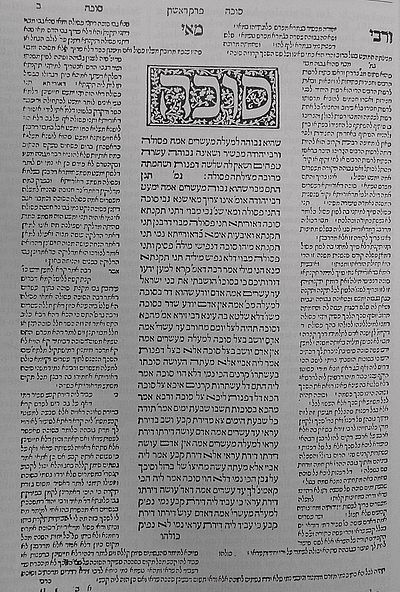
The earliest surviving manuscript of a complete Talmudic tractate is the Munich Manuscript (Cod. hebr. 95), dated to 1342, now in the Bavarian State Library. The first printed edition of the complete Babylonian Talmud was produced by Daniel Bomberg in Venice between 1520 and 1523. Its page layout — Mishnah and Gemara in the center, Rashi on the inner margin, Tosafot on the outer margin — became the standard that persists in every printed edition today.
Jewish Life in Roman Palestine Verified
Despite the catastrophic defeats of 70 and 135 CE, Jewish life in the land of Israel did not end. The center of population shifted from Judea to the Galilee, where major Jewish communities flourished for centuries. 
The city of Sepphoris (Tzippori), rebuilt after the Bar Kokhba revolt, became the seat of the Sanhedrin and the home of Rabbi Judah ha-Nasi. Tiberias, on the western shore of the Sea of Galilee, would later house the academy that produced the Jerusalem Talmud, the Masoretic vocalization of the Hebrew Bible, and important liturgical poetry (piyyut).
Archaeological evidence of this Galilean Jewish civilization is abundant and remarkable. Excavations at Sepphoris (led by Ehud Netzer, Zeev Weiss, and others) have revealed a prosperous, cosmopolitan city with Roman-style domestic architecture, elaborate mosaics, and a theater. Most strikingly, the synagogue at Sepphoris (5th century CE) contains a magnificent mosaic floor depicting the zodiac cycle with Helios (the sun god) driving a chariot at the center, surrounded by the twelve zodiac signs labeled in Hebrew, with personifications of the four seasons in the corners. Biblical scenes — including the binding of Isaac and the consecration of Aaron — appear in other panels.
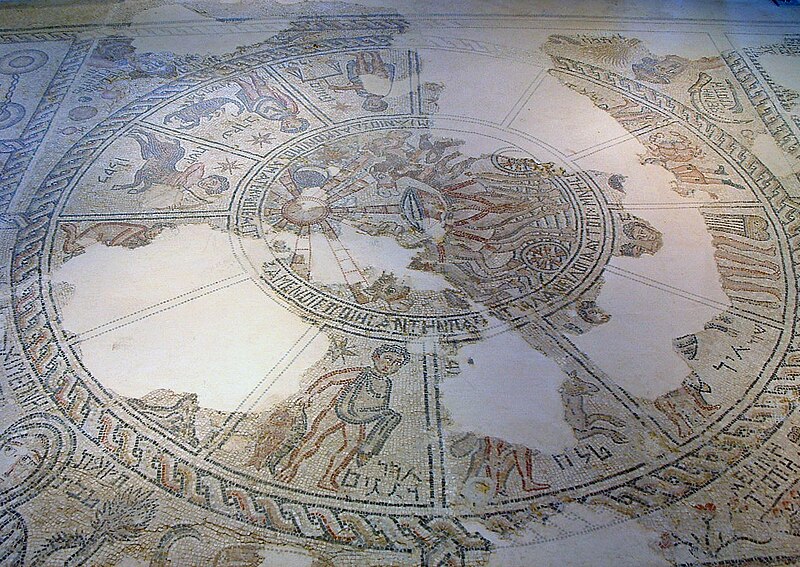
This zodiac motif appears in multiple ancient synagogues: at Beit Alpha (6th century, discovered in 1928 by members of Kibbutz Heftzibah, excavated by Eleazar Sukenik), where a naive but charming mosaic depicts the zodiac with Abraham and Isaac above and two flanking menorahs; at Hammat Tiberias (4th century), where a more sophisticated zodiac features a Helios figure surrounded by zodiac signs of high artistic quality; at Huseifa near Haifa; and at Na'aran near Jericho. The presence of seemingly pagan imagery in synagogues has challenged scholars' assumptions about Jewish aniconism and revealed a more complex relationship between Jewish communities and Greco-Roman visual culture than previously imagined.
The Bet She'arim Necropolis Verified
The ancient necropolis of Bet She'arim (Beit She'arim), located in the Jezreel Valley in the lower Galilee, provides the most extensive archaeological evidence of Jewish burial practices and communal life in the rabbinic period. Excavations by Benjamin Mazar (1936–1940) and Nahman Avigad (1953–1955) uncovered an enormous series of catacombs carved into the hillside, containing hundreds of sarcophagi and thousands of burials dating from the 2nd to the 4th centuries CE.
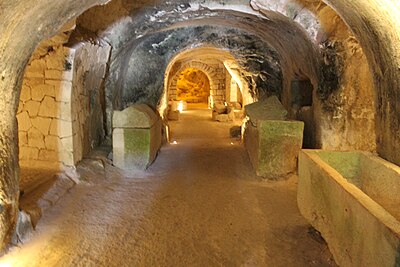
Bet She'arim was the seat of the Sanhedrin under Rabbi Judah ha-Nasi, and tradition held that Rabbi Judah himself was buried there. The identification of his tomb remains uncertain, but the necropolis's fame as a burial site for the patriarch attracted Jews from across the diaspora — inscriptions in Hebrew, Aramaic, Greek, and Palmyrene attest to the cosmopolitan origins of those interred there.
The sarcophagi are decorated with a rich array of images: menorahs, the Torah ark, the lulav and etrog, lions, eagles, human figures, and mythological scenes including the abduction of Europa and Leda and the swan. This visual eclecticism — mixing Jewish symbols with pagan mythology — parallels the zodiac mosaics in synagogues and complicates any simple narrative of Jewish iconophobia. Bet She'arim was designated a UNESCO World Heritage Site in 2015.
The Development of the Synagogue Verified
The synagogue as we know it — a dedicated building for communal prayer, Torah reading, and study — is fundamentally a rabbinic creation, even if its roots extend into the Second Temple period. After 70 CE, the synagogue assumed functions previously reserved for the Temple: regular communal worship with a fixed liturgy, public Torah reading on a triennial (in Palestine) or annual (in Babylonia) cycle, and the priestly blessing recited by kohanim.
Dozens of ancient synagogues have been excavated across Israel, the Golan Heights, and the diaspora. They reveal a diversity of architectural forms:
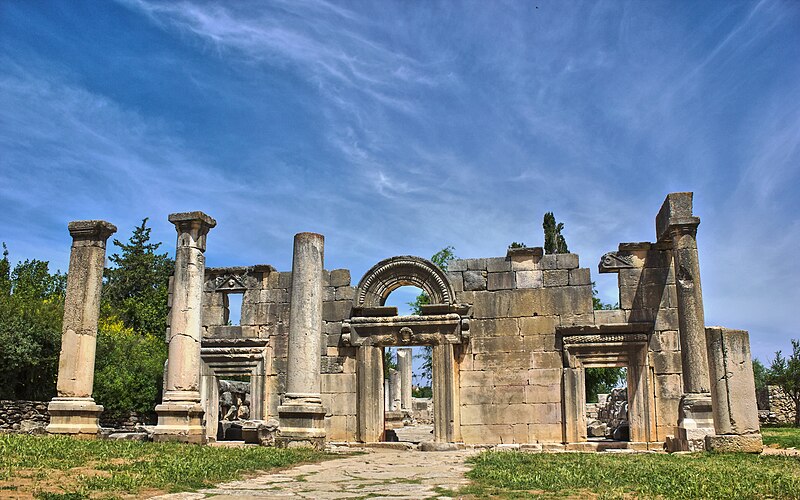
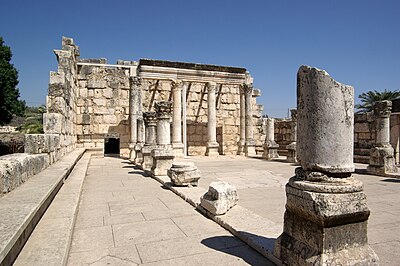
Galilean-type synagogues (3rd–4th centuries): Rectangular buildings with a triple-entrance facade oriented toward Jerusalem. The synagogues at Capernaum (the white limestone synagogue built over the basalt town), Chorazin, Bar'am, and Meiron exemplify this type. The Capernaum synagogue, partially restored, is one of the most visited archaeological sites in Israel.
Broadhouse synagogues: The prayer hall is wider than it is long, with the Torah shrine on the long wall facing Jerusalem. The 3rd-century synagogue at Khirbet Shema follows this plan.
Apsidal synagogues (5th–6th centuries): Featuring a semicircular apse for the Torah shrine, basilica-style columns, and elaborate mosaic floors. The synagogues at Beit Alpha, Sepphoris, and Maon (Nirim) are prime examples.
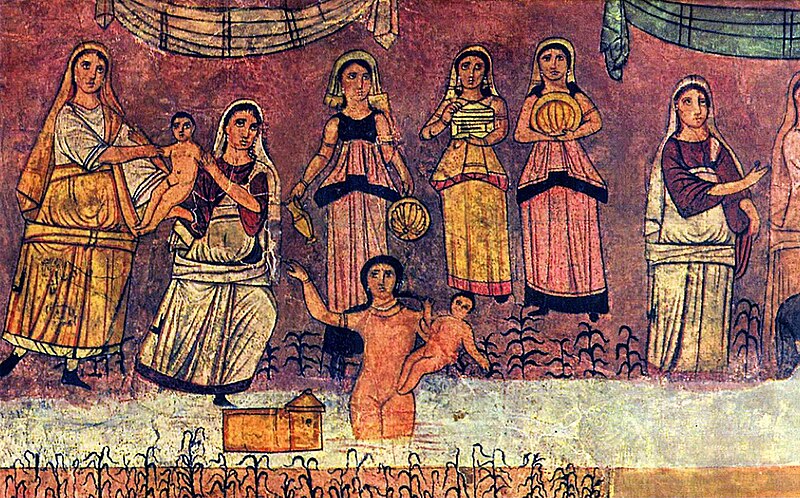
Diaspora synagogues: The 3rd-century synagogue at Dura-Europos in Syria (modern Salihiyah), discovered in 1932, contained stunning painted wall panels depicting biblical scenes — Ezekiel's vision of the dry bones, the Exodus, the Ark of the Covenant, Esther and Mordecai — in a Greco-Roman artistic style. These paintings, now reconstructed in the National Museum in Damascus (with reproductions at Yale University Art Gallery), overturned scholarly assumptions about Jewish attitudes toward figural art and remain among the most important discoveries in the history of ancient art.
Jewish Life in Sassanid Babylonia Verified
While Palestinian Jewry endured the increasingly hostile Christian Roman Empire, the Jewish community in Babylonia (Mesopotamia, modern Iraq) thrived under the relatively tolerant Sassanid Persian dynasty (224–651 CE). This community claimed roots stretching back to the Babylonian Exile of 586 BCE, and by the rabbinic period it numbered several hundred thousand — perhaps the largest single Jewish community in the world.
Babylonian Jews were led by the Exilarch (Resh Galuta), who claimed descent from King David and was recognized by the Sassanid authorities as the political head of the Jewish community. The Exilarch held a court of considerable splendor and exercised judicial authority over Jewish affairs.
The intellectual life of Babylonian Jewry was centered in the great academies (yeshivot): Sura (founded by Rav, c. 219 CE), Pumbedita (led by Samuel, then by a succession of brilliant scholars), and Nehardea (destroyed by a Palmyrene raid in 259 CE). The heads of these academies, known as geonim (singular gaon, "pride" or "eminence"), became the leading authorities of the Jewish world after the decline of the Palestinian center.
Archaeological evidence for Jewish life in Sassanid Babylonia is far more limited than for Palestine. The site of Nippur has yielded Aramaic incantation bowls — ceramic bowls inscribed with spiraling magical texts in Jewish Aramaic, invoking God and angels to protect householders from demons. Thousands of these bowls have been found across Iraq, dating primarily to the 5th–7th centuries CE, and they provide fascinating evidence of Jewish folk religion alongside the elite rabbinic culture of the academies. Major collections are held at the University of Pennsylvania Museum, the British Museum, and the Iraq Museum in Baghdad.
The Oral Torah as Living System Tradition
The rabbinic concept of the Oral Torah was not merely a claim about historical transmission. It was a theory of law and interpretation that granted the rabbis extraordinary creative authority. The Talmud (Bava Metzia 59b) preserves its most famous expression in the story of the Oven of Akhnai:
Rabbi Eliezer declared an oven ritually pure, while the majority of sages declared it impure. When Rabbi Eliezer invoked miraculous proofs — a carob tree flew 100 cubits, a stream of water reversed direction, the walls of the study house began to collapse — the majority remained unmoved. When a heavenly voice (bat kol) declared, "The halakhah is always in accordance with Rabbi Eliezer," Rabbi Joshua rose and quoted Deuteronomy 30:12: "Lo bashamayim hi — It is not in heaven!" The Torah had already been given at Sinai, and human reason, following majority rule, was the proper method of determining law. God, according to a postscript in the story, laughed and said, "My children have defeated me! My children have defeated me!"
This story, while not literally historical, expresses the revolutionary rabbinic claim that divine authority operates through human interpretation. The Torah is not a static document administered by prophets or priests; it is a living system developed through scholarly debate, guided by established hermeneutical principles, and determined by majority vote. This vision of law as an ongoing conversation — a conversation that included, in principle, every Jewish student who ever sat in a study hall — became the engine of Judaism's adaptability across vastly different times and places.
The Liturgical Revolution Tradition
The rabbis created a liturgical system that translated the rhythms of Temple worship into verbal prayer accessible to every Jew, regardless of location. The three daily prayer services — Shacharit (morning), Mincha (afternoon), and Ma'ariv (evening) — were mapped onto the schedule of Temple sacrifices. The central prayer, the Amidah (or Shemoneh Esrei, "Eighteen Benedictions"), was formulated at Yavneh and includes petitions for the restoration of the Temple, the ingathering of exiles, the rebuilding of Jerusalem, and the coming of the Messiah — ensuring that longing for return and redemption was embedded in the daily experience of Jewish prayer.
The Shema (Deuteronomy 6:4–9, 11:13–21, Numbers 15:37–41) became the fundamental declaration of Jewish faith, recited morning and evening. The Birkat HaMazon (Grace after Meals) sanctified the domestic table. The Sabbath Kiddush (sanctification over wine) and Havdalah (the ceremony marking the Sabbath's end) structured time. The annual cycle of Torah readings ensured that the entire Pentateuch was heard publicly each year (in the Babylonian custom) or every three years (in the Palestinian custom).
The rabbis also created the berakhah (blessing) formula — "Blessed are You, Lord our God, King of the universe, who..." — as a template for sanctifying virtually every human experience: eating, drinking, seeing natural phenomena, performing commandments, even hearing bad news. The Talmud (Menachot 43b) records that a Jew should recite 100 blessings daily — a practice that saturated ordinary life with religious consciousness.
The Patriarch and the End of an Era Verified
The office of the Nasi (Patriarch), established at Yavneh, continued for approximately four centuries. The Patriarch served as the recognized head of Palestinian Jewry, corresponding with diaspora communities, dispatching emissaries, and maintaining a court at Sepphoris and later Tiberias. Roman emperors acknowledged the Patriarch's authority through official correspondence, and the office carried the Roman rank of clarissimus and later illustris.
The last Patriarch, Gamaliel VI, died around 425 CE without an heir, and the Roman Emperor Theodosius II declined to appoint a successor. The patriarchal taxes were redirected to the imperial treasury. The end of the Patriarchate symbolized the declining status of Jews in the now-Christian Roman Empire. Theodosius's Codex (438 CE) included increasingly restrictive legislation against Jews — prohibiting the construction of new synagogues, barring Jews from holding public office, and criminalizing conversion to Judaism.
Yet the institutions the rabbis built — the synagogue, the academy, the liturgical calendar, the Talmudic legal system — proved more durable than any political office. When the Patriarchate ended, Judaism did not collapse. The academy at Tiberias continued to produce scholarship, including the Masoretic system of vowel notation that ensured the precise pronunciation of the Hebrew Bible for all subsequent generations. The center of Jewish creativity was already shifting to Babylonia, where the great Talmudic academies of Sura and Pumbedita would continue to flourish for another five hundred years.
Legacy: The Portable Homeland Tradition
The achievement of the rabbis who built Judaism between 70 and 500 CE is almost impossible to overstate. They took a religion centered on a single sanctuary, a hereditary priesthood, and an agricultural calendar tied to the land of Israel, and transformed it into a portable civilization that could survive and flourish anywhere on earth. The Talmud became, in Heinrich Heine's phrase, the "portable homeland" of the Jewish people — a world of law, story, and intellectual engagement that Jews could carry with them through every exile.
This transformation was not without cost. The priestly aristocracy lost its preeminence. Women, already marginal in the Temple cult, were further excluded from the study halls that became the new centers of authority. Regional diversity gave way to the standardizing influence of Talmudic law. And the messianic hope — the fervent expectation that God would restore the Temple, the monarchy, and Jewish sovereignty — was channeled into liturgy and eschatology rather than political action, a posture that would shape Jewish life until the modern era.
Yet the rabbinic achievement endures. Every synagogue in the world follows patterns established in the Galilean and Babylonian academies. Every Passover seder reenacts the rabbinic response to the Temple's destruction. Every page of Talmud studied — and the Talmud is studied by hundreds of thousands of Jews daily through the Daf Yomi cycle inaugurated in 1923 — is a testament to the conviction that the conversation begun at Yavneh will never end.
Piyyut: The Poetry of Prayer Verified
One of the most creative literary achievements of the late antique period was piyyut — liturgical poetry composed for inclusion in synagogue services. The earliest known paytanim (liturgical poets) worked in the Land of Israel during the 5th to 7th centuries CE, and their compositions represent some of the most sophisticated Hebrew poetry written since the biblical period.
Yose ben Yose (5th century): The earliest named paytan, he composed avodah poems for Yom Kippur that reconstructed the Temple service in vivid poetic language — allowing the congregation to experience vicariously what they could no longer perform.
Yannai (6th century): A prolific poet whose works were largely lost until fragments were discovered in the Cairo Geniza by Israel Davidson and Menahem Zulay in the early 20th century. Yannai composed kerovot (insertions into the Amidah prayer) for the entire triennial Torah reading cycle — over 1,000 poems.
Eleazar ha-Kallir (6th–7th century): The most influential of the Palestinian paytanim, ha-Kallir composed in a dense, allusive style packed with biblical references, wordplay, and acrostics. His compositions for the High Holidays and festivals remain part of the Ashkenazi liturgy today. The kinot recited on Tisha B'Av include several of his elegies, their baroque language intensifying the emotional impact of communal mourning.
The Geniza Factor: Thousands of piyyut fragments were preserved in the Cairo Geniza, allowing modern scholars — particularly Ezra Fleischer and Shulamit Elizur — to reconstruct the liturgical life of ancient Palestinian synagogues in unprecedented detail. These fragments reveal a far richer and more diverse liturgical tradition than the standardized prayer books of later centuries would suggest.
These poets transformed the synagogue service from a standardized liturgical formula into a living literary experience. Their work demonstrates that the rabbis' turn to prayer as a replacement for sacrifice did not produce a static worship practice but a dynamic, evolving art form that continued to develop across the centuries.
Locations in This Chapter
Loading map...