Part 5: Diaspora & Rabbinic Judaism · 1096–1500 CE
19.Medieval Christendom
Crusades, blood libels, expulsions, Kabbalah
22 min read
The Rhineland Massacres of 1096 Verified
In the spring of 1096, as the armies of the First Crusade gathered to liberate Jerusalem from Muslim rule, bands of Crusaders turned their violence against a closer target: the Jewish communities of the Rhineland. The massacres that followed — in Speyer, Worms, Mainz, Cologne, Trier, and other cities — constituted the worst persecution of European Jews since the Roman era and inaugurated a new chapter of Jewish suffering in Christian Europe.
The Crusader violence was not centrally directed. While Pope Urban II's call to arms at Clermont in November 1095 targeted Muslims in the Holy Land, popular preachers like Peter the Hermit and local leaders like Count Emicho of Flonheim channeled popular fervor against local Jews. The logic, as recorded in the Hebrew chronicles, was brutally simple: "Why should we travel to distant lands to fight the enemies of God when His worst enemies — the Jews who killed Christ — live among us?"
The Jewish communities of the Rhineland were ancient, prosperous, and deeply rooted. Known collectively as ShUM (an acronym of their Hebrew names: Shpira/Speyer, Urmayza/Worms, Magenza/Mainz), they had been centers of Jewish learning for over a century. Rabbenu Gershom ben Judah (c. 960–1040 CE), called "the Light of the Exile" (Me'or ha-Golah), had studied and taught in Mainz, issuing takkanot (communal regulations) including a famous ban on polygamy for Ashkenazi Jews. The ShUM communities were designated a UNESCO World Heritage Site in 2021, recognizing their foundational role in Ashkenazi Jewish culture.
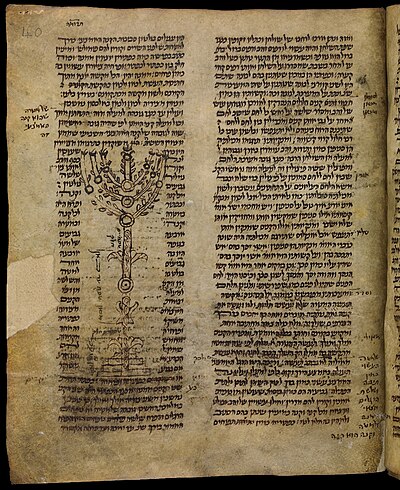
Three Hebrew chronicles describe the events of 1096 in harrowing detail: the chronicles attributed to Solomon bar Simson, Eliezer bar Nathan, and an anonymous Mainz chronicler. These texts, preserved in medieval manuscripts and published critically by Adolf Neubauer and Moritz Stern in 1892, describe Jews who chose death rather than baptism — acts of kiddush Hashem (sanctification of God's name) that included parents killing their children and then themselves. At Mainz, where the largest community was destroyed, the chronicles record that approximately 1,100 Jews perished. At Worms, the community sought refuge in the bishop's palace but was eventually overwhelmed.
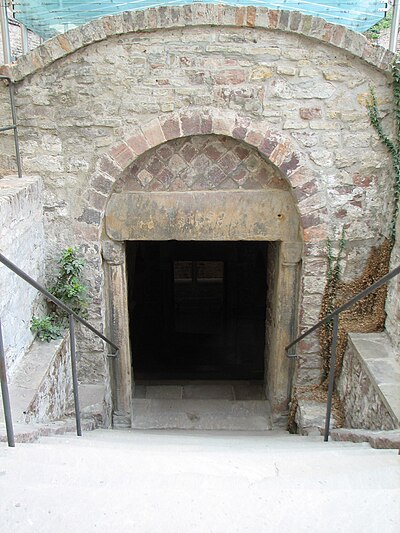
Archaeological evidence of the Rhineland communities includes the medieval synagogue and mikveh at Worms (the oldest in Europe north of the Alps, with origins in the 11th century, destroyed in 1938, reconstructed in 1961), the medieval mikveh at Speyer (dating to c. 1128, one of the best-preserved medieval Jewish ritual baths, still accessible to visitors), and the medieval Jewish cemetery at Worms (the oldest Jewish cemetery in Europe, with gravestones dating to the 11th century).
Blood Libel: The Anatomy of a Lie Verified
Among the most destructive falsehoods in history is the blood libel — the accusation that Jews murdered Christian children to use their blood in religious rituals, particularly in the baking of Passover matzah. This accusation, which has absolutely no basis in Jewish law or practice (Jewish law categorically prohibits the consumption of any blood, as stated in Leviticus 17:10–14 and elaborated extensively in the Talmud), first appeared in England in 1144 and spread across Europe over the following centuries, provoking massacres, expulsions, and judicial murders.
The first recorded case involved William of Norwich, a 12-year-old English boy found dead in the woods outside Norwich in 1144. A converted Jew named Theobald of Cambridge alleged that Jews had crucified the boy as part of a Passover ritual. Despite the lack of evidence and the skepticism of local authorities, the story gained currency and William was venerated as a martyr. The monk Thomas of Monmouth composed a hagiographic account, The Life and Passion of St. William of Norwich (c. 1173), which became a template for subsequent blood libel accusations.
The pattern repeated with tragic regularity: in Blois (1171), where 31 Jews were burned alive based on the testimony of a single servant; in Lincoln, England (1255), where the death of "Little Hugh" led to the arrest of 90 Jews and the execution of 18; in Trent (1475), where the child Simon was venerated as a saint until the Catholic Church formally repudiated the cult in 1965; and in hundreds of other cases across Europe.
Multiple popes issued bulls explicitly denying the blood libel. Pope Innocent IV, in the bull Lachrymabilem Judaeorum (1247), declared that Jews "are falsely accused" and that their religion actually forbids them to consume blood. Pope Gregory X reiterated this in 1272. These papal denunciations had limited practical effect — the accusation proved more powerful than its refutation.
The blood libel is universally recognized by modern historians and the Catholic Church as a fabrication. Pope Benedict XIV in 1758 and the Second Vatican Council's Nostra Aetate (1965) formally repudiated anti-Jewish accusations. Yet the blood libel persists in antisemitic propaganda to this day, surfacing in modern media across the Middle East and in extremist discourse worldwide.
The Fourth Lateran Council and the Yellow Badge Verified
In 1215, Pope Innocent III convened the Fourth Lateran Council, one of the most important ecclesiastical assemblies of the medieval period. Among its 70 canons, Canon 68 decreed that Jews (and Muslims) must wear distinctive clothing to distinguish them from Christians, preventing inadvertent social and sexual mixing. The stated rationale was to prevent Christians from accidentally entering into relationships with non-Christians.
The specific form of the distinguishing mark varied by region and period. In France, it was typically a circular yellow patch (la rouelle) sewn on the chest. In England, it took the form of two tablets representing the Tablets of the Law. In the German lands, the Judenhut (pointed hat) served a similar function. In some Italian cities, Jews were required to wear a yellow or red hat.
The yellow badge was an instrument of humiliation and social control. It marked Jews as visibly other in public space, facilitated surveillance, and exposed them to harassment and violence. Some Jewish communities were able to purchase temporary exemptions from the requirement. The badge fell into disuse in some regions during the late medieval period but was revived — with devastating intent — by Nazi Germany, which required Jews to wear the yellow Star of David (Judenstern) beginning in 1941.
The Great Expulsions Verified
Between the 13th and 15th centuries, Jews were expelled from nearly every major kingdom in Western Europe, a pattern of displacement that reshaped the geography of Jewish life:
England (1290): King Edward I issued the Edict of Expulsion on July 18, 1290, making England the first European kingdom to expel its entire Jewish population. An estimated 2,000–3,000 Jews were forced to leave, most crossing to France or the Low Countries. Jews were not officially readmitted to England until 1656, under Oliver Cromwell. The medieval Exchequer of the Jews records, preserved in the National Archives at Kew, document the financial transactions and legal status of English Jewry before the expulsion.
France (1306, 1394): King Philip IV expelled the Jews of France in 1306, confiscating their property. Jews were readmitted in 1315 and expelled again in 1322. A final expulsion in 1394 under Charles VI effectively ended the medieval Jewish community of France, though small communities persisted in Provence (under papal jurisdiction) and Alsace. The beautiful medieval manuscripts produced by French Jewish scribes — including the illuminated Prato Haggadah (c. 1300, now in the Jewish Theological Seminary, New York) — testify to the cultural sophistication of the community that was destroyed.
Spain (1492): The most consequential expulsion came on March 31, 1492, when Ferdinand and Isabella issued the Alhambra Decree, ordering all Jews to convert to Christianity or leave Spain within four months. An estimated 100,000–200,000 Jews left, many settling in the Ottoman Empire, North Africa, Italy, and the Netherlands. Those who remained and converted — the conversos or New Christians — were subjected to the scrutiny of the Spanish Inquisition, which suspected them of secretly practicing Judaism (Judaizing). The Inquisition's records, preserved in the Archivo Historico Nacional in Madrid and other archives, document the surveillance, torture, and execution of thousands of conversos over the following centuries.
The Spanish expulsion ended the greatest Jewish community in medieval Europe and created the Sephardic diaspora — communities that preserved the Judeo-Spanish language (Ladino), distinctive liturgical traditions, and a rich cultural heritage that persists to this day, particularly in Turkey, Greece, Morocco, and Israel.
Rashi and the Tosafists Verified
The intellectual life of medieval Ashkenazi Jewry achieved its greatest expression in the biblical and Talmudic commentary of Rashi and his successors.
Rashi (1040–1105 CE): Rabbi Shlomo Yitzchaki, known universally by his acronym, was born and lived in Troyes, in the Champagne region of France. His commentary on the Torah is the most widely studied Jewish biblical commentary ever written — printed in virtually every edition of the Hebrew Bible from the 15th century onward, it is the first text studied by Jewish children in traditional education. Rashi's genius lay in his ability to synthesize rabbinic midrash, grammatical analysis, and plain-sense (peshat) interpretation in concise, lucid Hebrew. His Talmud commentary, covering nearly the entire Babylonian Talmud, is printed on every page of the standard Vilna edition and remains essential for Talmud study.
Rashi also maintained a vineyard and was deeply rooted in the daily life of his community. His responsa and glosses include Old French words (la'azim) that preserve medieval French vocabulary found in no other source — making Rashi's commentaries a resource for Romance linguistics as well as Jewish studies. Over 3,000 Old French glosses have been identified in his works.
The Tosafists: Rashi's grandsons and their students, known as the Ba'alei ha-Tosafot ("Masters of the Additions"), produced intricate dialectical commentaries on the Talmud that are printed on the outer margin of the standard Talmud page, opposite Rashi's commentary. The most prominent Tosafists included Rabbenu Tam (Jacob ben Meir, 1100–1171, Rashi's grandson), Rashbam (Samuel ben Meir, c. 1085–1158, another grandson), and Rabbi Isaac of Dampierre (Ri ha-Zaken, d. 1189). The Tosafists' method of comparing and reconciling contradictory Talmudic passages — identifying difficulties (kushyot) and resolving them through subtle distinctions — became the model for advanced Talmud study that persists in yeshivot to this day.
The Black Death Massacres Verified
The Black Death (bubonic plague), which devastated Europe between 1347 and 1351, killing an estimated one-third to one-half of the population, provoked a wave of violence against Jews that rivaled the Crusade massacres in scale and exceeded them in geographic scope.
As the plague spread, rumors that Jews had poisoned wells to cause the epidemic gained widespread credence. The accusations began in southern France in the spring of 1348 and spread rapidly northward and eastward. In September 1348, the Jewish community of Chillon (on Lake Geneva) was subjected to judicial torture until confessions of well-poisoning were extracted — confessions whose details were circulated to other cities, fueling further violence.
On February 14, 1349 — St. Valentine's Day — the Jewish community of Strasbourg was burned alive on a wooden scaffold, estimated at 900 to 2,000 people, in what was later called the Strasbourg Massacre. The city council had initially attempted to protect the Jews, but was overthrown by a guild revolt that demanded their destruction. Similar massacres occurred in Basel, Freiburg, Augsburg, Nuremberg, Cologne, and throughout the Holy Roman Empire. Pope Clement VI issued two bulls (July and September 1348) declaring that Jews were dying of the plague at the same rate as Christians — proving they were not responsible — but his intervention failed to stem the violence.
The Black Death massacres accelerated the eastward migration of Ashkenazi Jews from the Rhineland and central Europe to Poland and Lithuania, where they received royal charters of protection and established the communities that would become the heartland of Ashkenazi civilization for the next five centuries.
The Zohar and Kabbalistic Mysticism Debated
While Ashkenazi Jews produced legal and exegetical masterworks, a parallel tradition of Jewish mysticism — Kabbalah — developed primarily in southern France and Spain during the 12th and 13th centuries.
Kabbalah (kabbalah, "reception" or "tradition") presented itself as ancient wisdom transmitted secretly from master to student, ultimately originating at Sinai or even with Adam. Its central concern was the inner life of God — the dynamic interplay of divine attributes (sefirot) that constitutes the hidden structure of reality.
The Sefer ha-Bahir ("Book of Brightness"), which appeared in Provence around 1176, introduced many key kabbalistic concepts, including the sefirot and the idea of transmigration of souls (gilgul). The Gerona school of Kabbalah, led by Nachmanides (Rabbi Moses ben Nachman, 1194–1270) and his student Azriel of Gerona, developed sophisticated theosophical teachings that circulated among small circles of initiates.
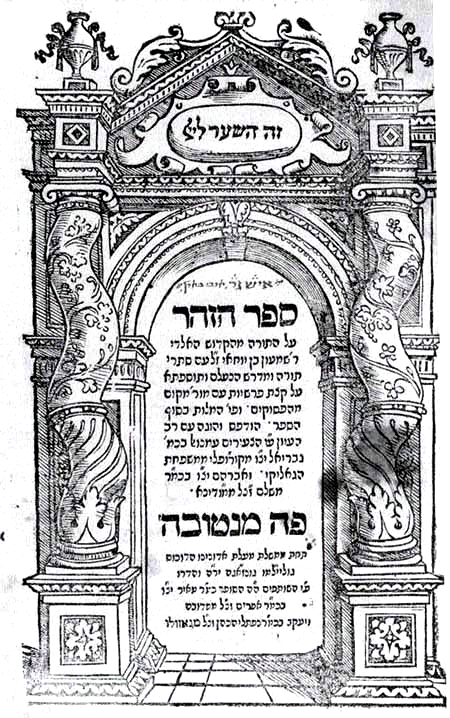
The masterwork of medieval Kabbalah is the Zohar ("Book of Splendor"), a vast collection of mystical commentaries on the Torah written in an ornate literary Aramaic. The Zohar presents itself as the teachings of the 2nd-century sage Rabbi Shimon bar Yochai, transmitted to his disciples in the Land of Israel. However, modern scholarship, beginning with the historian Heinrich Graetz (1871) and decisively demonstrated by Gershom Scholem in his groundbreaking Major Trends in Jewish Mysticism (1941), has established that the Zohar was primarily composed by the Spanish kabbalist Moses de Leon (c. 1240–1305) in Castile during the 1280s and 1290s. The evidence includes linguistic analysis (the Aramaic contains medieval Castilian syntax), historical anachronisms, and testimony from contemporaries.
The Zohar's cosmology describes a divine realm of ten sefirot — emanations or attributes through which the Infinite (Ein Sof) manifests in creation. These include Keter (Crown), Chokhmah (Wisdom), Binah (Understanding), Chesed (Loving-kindness), Gevurah (Severity), Tiferet (Beauty), Netzach (Eternity), Hod (Splendor), Yesod (Foundation), and Malkhut/Shekhinah (Sovereignty/Divine Presence). Human actions — particularly the performance of commandments — affect the harmony or disharmony of the sefirot, giving humanity a cosmic role in sustaining the divine order.
Whether Moses de Leon was the Zohar's sole author, its primary compiler, or the editor of earlier traditions remains debated. Yehuda Liebes and other scholars have argued for a circle of authorship, while Daniel Matt — whose monumental annotated English translation (The Zohar: Pritzker Edition, 12 volumes, 2004–2017) is the definitive scholarly edition — has identified multiple literary strata within the text.
Jewish Intellectual Life Despite Persecution Verified
The paradox of medieval Jewish life in Christendom is that extraordinary intellectual creativity coexisted with devastating persecution. The same centuries that produced the Crusade massacres, blood libels, and expulsions also witnessed the flourishing of Talmudic academies, mystical speculation, and philosophical inquiry.
In addition to Rashi and the Tosafists, notable figures include:
Nachmanides (Ramban, 1194–1270): The leading rabbi of Spain, Nachmanides combined Talmudic mastery with kabbalistic learning and biblical commentary. In 1263, he was compelled to participate in the Barcelona Disputation — a public debate with the Dominican friar Pablo Christiani, staged before King James I of Aragon. Nachmanides argued that the Talmudic passages cited by Pablo did not prove that the Messiah had come and that Jews were not obligated to accept Christian interpretation of their own texts. He was initially praised by King James for his courage but was later convicted of blasphemy and forced into exile. He settled in the Land of Israel, where his letter describing the desolation of Jerusalem and the tiny Jewish community he found there (1267) is a poignant historical document.
Asher ben Yehiel (the Rosh, 1250–1327): A leading student of Rabbi Meir of Rothenburg, the Rosh fled Germany after his teacher was imprisoned by Emperor Rudolf I (and died in captivity in 1293 after the community refused to pay an extortionate ransom). He settled in Toledo, Spain, where he became chief rabbi and combined the Ashkenazi Tosafist tradition with Sephardic legal methodology, creating a synthesis that influenced subsequent codifiers, particularly his son Jacob ben Asher, whose Arba'ah Turim ("Four Rows") organized Jewish law into four sections that Maimonides had not used — and which Joseph Karo later adopted for his Shulchan Arukh.
The Prague Altneuschul Verified
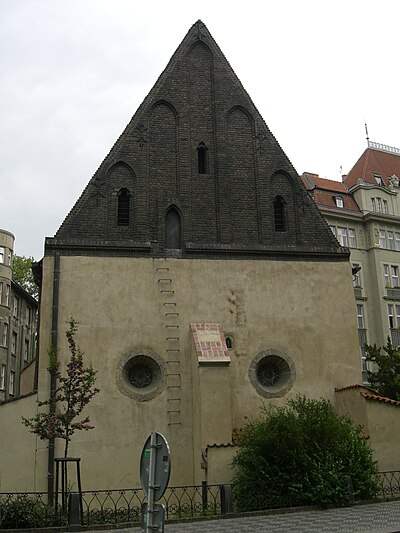
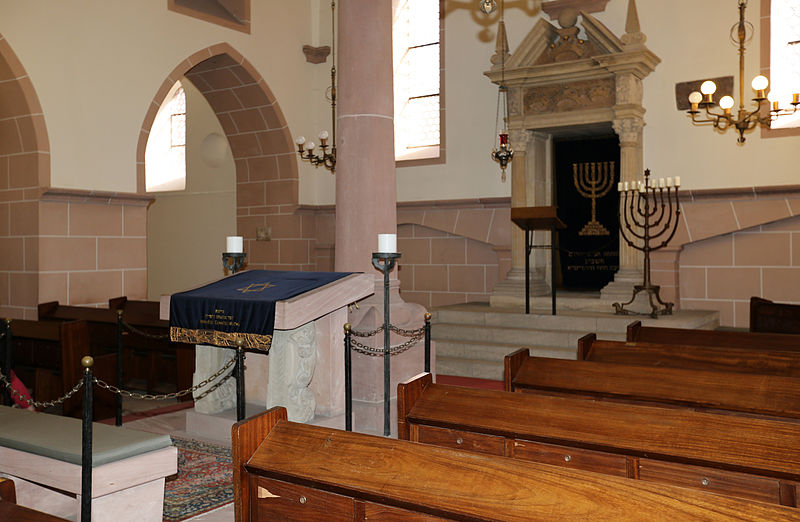
The Old-New Synagogue (Altneuschul) in Prague is the oldest active synagogue in Europe and one of the earliest surviving Gothic structures in the city. Built around 1270, its double-naved hall with ribbed vaulting (unusually using five ribs rather than four, possibly to avoid the cruciform pattern) has served the Prague Jewish community continuously for over 750 years, interrupted only during the Nazi occupation.
The Altneuschul is associated in legend with Rabbi Judah Loew ben Bezalel, the Maharal of Prague (c. 1520–1609), who — according to tradition — created a Golem, an artificial being made of clay, to protect the Jewish community from blood libel accusations and anti-Jewish violence. The Golem legend, which gained its best-known literary form in the 19th century, reflects the Jewish community's desperate desire for protection in a hostile environment.
The Prague Jewish quarter (Josefov) also contains the Old Jewish Cemetery, where approximately 12,000 tombstones — layered up to 12 deep due to limited space — mark burials from the 15th to 18th centuries. The Maharal's grave, identifiable by its distinctive marker, remains a site of Jewish pilgrimage. The Prague Jewish Museum, established in 1906, houses one of the world's most important collections of Judaica, including Torah textiles, silver ceremonial objects, manuscripts, and — most hauntingly — drawings made by children in the Terezin (Theresienstadt) concentration camp.
Jewish-Christian Disputations Verified
The medieval period witnessed a series of forced public disputations in which Jewish scholars were compelled to defend their faith against Christian theologians — events that combined theological debate with political coercion.
The Paris Disputation (1240): Perhaps the most consequential, this "trial" of the Talmud was instigated by Nicholas Donin, a Jewish convert to Christianity who presented 35 charges against the Talmud to Pope Gregory IX, alleging that it contained blasphemies against Jesus and Mary and that it had replaced the Bible as the true focus of Jewish devotion. Rabbi Yehiel of Paris defended the Talmud before a tribunal headed by Blanche of Castile. The outcome was predetermined — 24 cartloads of Talmud manuscripts (approximately 10,000 volumes according to some accounts) were publicly burned in the Place de Greve in Paris on June 17, 1242. This was the first large-scale burning of Jewish books in Europe and set a devastating precedent.
The Barcelona Disputation (1263): As discussed earlier, Nachmanides defended Judaism with remarkable courage and skill. The relatively favorable outcome — at least initially — reflected the greater sophistication of the Aragonese court compared to the Paris proceedings.
The Tortosa Disputation (1413–1414): The longest and most exhausting of the medieval disputations, lasting 69 sessions over 21 months. The anti-pope Benedict XIII convened the disputation in Tortosa, Aragon, compelling Jewish leaders from across the kingdom to attend. The Christian representative, the convert Geronimo de Santa Fe (formerly Joshua Lorki), argued that the Talmud itself proved that the Messiah had come. The prolonged pressure of the disputation, combined with intensifying persecution, led to a wave of conversions — an outcome that was clearly the organizers' intention.
These disputations were not genuine dialogues but exercises of power. The Jewish participants operated under extreme constraints — they could not freely criticize Christianity, they faced punishment if their arguments were deemed blasphemous, and the outcomes were often predetermined. Yet the Jewish records of these events — particularly Nachmanides' account of the Barcelona Disputation — preserve eloquent defenses of Jewish faith and identity under duress.
The Eve of Expulsion Tradition
By 1500, the map of Jewish Europe had been radically redrawn. Western Europe — England, France, and most of the German lands — had expelled or drastically reduced its Jewish populations. Spain's Jews were gone. The future of European Jewry lay to the east — in Poland, Lithuania, and the Ottoman Empire — where new chapters of Jewish civilization were about to be written.
The rabbis who lived through these centuries of persecution developed a theology of exile (galut) that interpreted Jewish suffering as divine discipline, as atonement for communal sin, or as a necessary stage in the unfolding of redemption. The liturgical poem Av HaRachamim ("Father of Mercy"), composed in memory of the Rhineland martyrs, was incorporated into the Sabbath morning service and is recited to this day. The kinot (elegies) of Tisha B'Av expanded to include laments for the Crusade massacres. Jewish memory absorbed each catastrophe into a larger narrative of suffering and hope — a narrative that gave meaning to the incomprehensible and sustained the determination to survive.
Jewish Moneylending and Economic Life Verified
The popular image of the medieval Jew as moneylender, while reductive, reflects a real historical phenomenon. Excluded from guilds, land ownership, and most agricultural pursuits, and finding their commercial activities increasingly restricted, many Jews in medieval Christendom turned to moneylending — one of the few economic niches available to them.
Christian canon law prohibited usury (lending at interest) among Christians, based on biblical injunctions (Exodus 22:25, Deuteronomy 23:19–20). Jewish law similarly prohibited interest-bearing loans between Jews but permitted them with non-Jews. This legal asymmetry created a functional role for Jewish lenders in the medieval economy — kings, nobles, merchants, and even churches borrowed from Jewish financiers.
The relationship was inherently precarious. Jewish lenders operated under royal protection, which could be withdrawn at any moment. Kings frequently taxed Jewish lending profits heavily, effectively using Jews as a mechanism for indirect taxation of the Christian population. When debts became inconvenient, rulers could expel the Jews and cancel the debts — as Edward I did in England in 1290.
The association of Jews with money bred resentment that fed into broader antisemitic tropes. Dante placed usurers in the seventh circle of Hell. Shakespeare's Shylock, whatever the playwright's intentions, crystallized a stereotype that persists in antisemitic imagery to this day. The historical reality was far more complex: Jewish moneylenders were a small minority of the Jewish population, most Jews were poor, and the economic role they played was imposed on them by exclusionary laws rather than freely chosen.
The medieval period also bequeathed enduring institutional forms: the kehillah (organized Jewish community), the hevra kaddisha (burial society), the beit din (rabbinical court), the heder (elementary school), and the yeshiva (advanced academy). These structures would prove flexible enough to adapt to vastly different political, economic, and cultural environments — from the shtetls of Eastern Europe to the mellahs of Morocco to the emerging communities of the New World.
The Regensburg Synagogue and Material Culture Verified
Archaeological and architectural remains of medieval Jewish life in Christendom, while less abundant than textual sources, provide tangible evidence of the communities described above.
The medieval mikveh of Cologne (c. 1170), discovered in 1956 during construction near the city hall, is one of the best-preserved medieval Jewish ritual baths in Europe. Located seven meters below street level, it was accessed by a monumental staircase and fed by groundwater. The City of Cologne is building the MiQua — LVR Jewish Museum in the Archaeological Quarter — scheduled to open over the excavated remains.
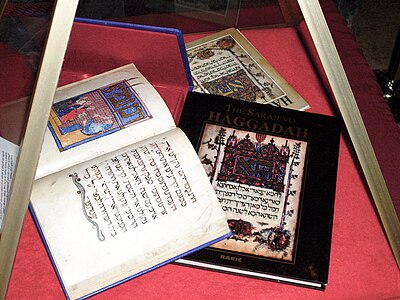
Medieval illuminated Hebrew manuscripts — the Bird's Head Haggadah (c. 1300, now in the Israel Museum), the Sarajevo Haggadah (c. 1350, now in the National Museum of Bosnia and Herzegovina), the Golden Haggadah (c. 1320, now in the British Library), and the Rothschild Miscellany (c. 1479, now in the Israel Museum) — reveal a rich tradition of Jewish book art that drew on both Christian and Islamic artistic conventions while maintaining distinctively Jewish iconographic programs.
The Erfurt Treasure — a hoard of gold and silver objects, coins, and a magnificent Jewish wedding ring discovered in the wall of a house in Erfurt, Germany, in 1998 — provides material evidence of the wealth accumulated by some Jewish families before the Black Death massacres. The treasure, likely hidden during the 1349 pogrom by a Jewish family that never returned to retrieve it, is now displayed in the Old Synagogue of Erfurt (itself a remarkable survival, dating to the 11th century and now a museum).
These manuscripts, produced at enormous expense for wealthy patrons, survived the centuries by remarkable luck — hidden in attics, preserved in church treasuries (sometimes as curiosities), or carried by refugees across borders. Each is a physical testament to the cultural vitality that persisted even in the shadow of persecution.
Locations in This Chapter
Loading map...