Part 4: Second Temple · 70–136 CE
16.Destruction of Second Temple
Josephus, Arch of Titus, Bar Kokhba
22 min read
The Great Revolt Begins Verified
In the spring of 66 CE, the procurator Gessius Florus seized 17 talents from the Temple treasury, ostensibly to cover unpaid taxes. When Jews protested, Florus unleashed his soldiers on the Jerusalem marketplace, killing an estimated 3,600 men, women, and children according to Josephus (Jewish War 2.307). This massacre ignited the Great Jewish Revolt — one of the most consequential conflicts in ancient history.
The revolt was not merely a reaction to Florus. Decades of misgovernment, economic oppression, social inequality, and apocalyptic fervor had created a powder keg. The young Temple captain Eleazar ben Ananias halted the daily sacrifice offered on behalf of the Roman emperor — an act of open rebellion. Jewish insurgents overran the Roman garrison at the Antonia Fortress, and the moderate priestly aristocracy lost control of Jerusalem to radical factions.
In November 66 CE, the Syrian legate Cestius Gallus marched south with Legio XII Fulminata to suppress the revolt. After briefly penetrating Jerusalem's outer walls, he inexplicably withdrew — and his retreating column was ambushed and routed at the Beth Horon pass. The legionary eagle of XII Fulminata was captured, a catastrophic disgrace. The Battle of Beth Horon convinced many Jews that God was fighting on their side. It also convinced Rome that a major military response was required.
Josephus: Historian and Eyewitness Debated
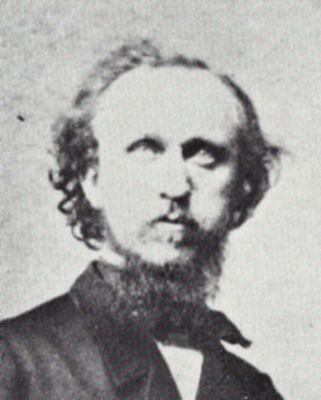
Flavius Josephus (born Yosef ben Matityahu, 37–c. 100 CE) is the indispensable source for this period — and one of the most controversial figures in Jewish history. Born into a priestly family in Jerusalem, Josephus commanded Jewish forces in the Galilee during the revolt. When the Romans besieged his stronghold at Jotapata in 67 CE, Josephus survived a collective suicide pact (by his own account, through a combination of calculation and divine providence) and surrendered to the Roman general Vespasian. He prophesied that Vespasian would become emperor — a prediction that came true in 69 CE — and spent the rest of the war as a Roman client, serving as interpreter and intermediary during the siege of Jerusalem.
After the war, Josephus lived in Rome under imperial patronage and produced four major works: The Jewish War (c. 75 CE), Jewish Antiquities (c. 93 CE), The Life (autobiography), and Against Apion (a defense of Judaism). His works preserve the most detailed account of Jewish life, politics, and religion in the late Second Temple period. Without Josephus, our knowledge of this era would be fragmentary at best.
Yet Josephus's reliability is endlessly debated. He wrote as a defeated general justifying his surrender, a Jewish turncoat serving Roman masters, and an apologist for both Roman power and Jewish civilization. His casualty figures are almost certainly exaggerated. His self-serving narrative of the Jotapata suicide pact strains credulity. His portrait of the Jewish factions is colored by his hostility toward the Zealots and his sympathy for the Pharisees. Modern scholars like Shaye Cohen, Tessa Rajak, and Steve Mason have produced sophisticated analyses of Josephus's rhetorical strategies, biases, and sources, making it possible to read his works critically while recognizing their irreplaceable value.
The Siege of Jerusalem Verified
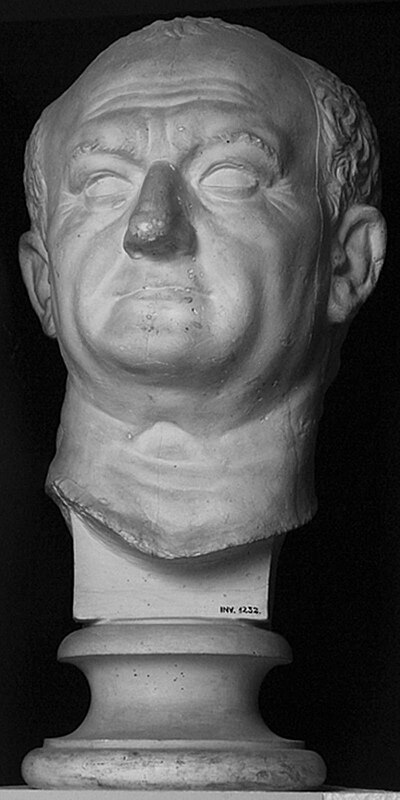
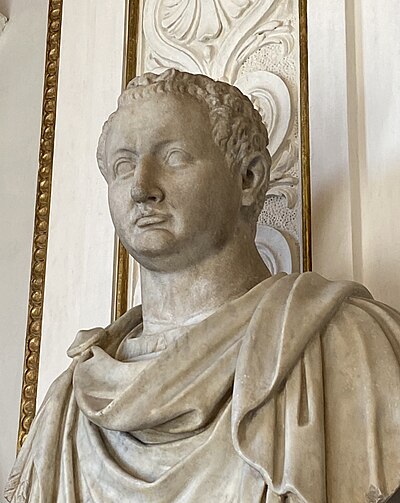
In the spring of 70 CE, Titus — son of Emperor Vespasian — arrived before Jerusalem with four legions (V Macedonica, X Fretensis, XII Fulminata, and XV Apollinaris), plus auxiliary troops, totaling perhaps 60,000–80,000 soldiers. Jerusalem's population, swollen by Passover pilgrims trapped inside the walls, may have reached several hundred thousand.
The city was divided among three rival Jewish factions: Simon bar Giora held the Upper City, John of Gischala the Temple Mount, and Eleazar ben Simon the inner Temple courts. These factions fought each other even as the Romans closed in — burning each other's food supplies in acts of internecine savagery that Josephus depicts with bitter anguish.
The Romans systematically reduced the city's three walls over several months. They built a siege wall (circumvallatio) around the entire city to prevent escape, creating conditions of extreme famine. Josephus describes scenes of desperate hunger — mothers eating their own children, people searching sewers for scraps — that became seared into Jewish collective memory.
Archaeological evidence of the siege is extensive. Excavations in Jerusalem's Jewish Quarter by Nahman Avigad uncovered the "Burnt House" — a priestly mansion destroyed by fire in August or September of 70 CE, its rooms filled with collapsed stone, charred wooden beams, and the arm bone of a young woman reaching toward the doorstep. A stone weight found in the house bore the inscription "of Bar Kathros," a priestly family criticized in rabbinic tradition for corruption. The Burnt House is now preserved as an underground museum in the Jewish Quarter.
Along the base of the Western Wall, Benjamin Mazar's excavations (1968–1978) found massive Herodian stones toppled from the Temple Mount, crashing onto the paved street below. Some stones still bear the marks of the fire that weakened the wall above. One stone, inscribed in Hebrew l'beit ha-tekiah — "to the place of trumpeting" — marked the southwest corner where priests blew the shofar to announce Sabbaths and festivals.
The Destruction of the Temple Tradition
According to Josephus (Jewish War 6.236–266), Titus did not intend to destroy the Temple. In a council of war, he argued for preserving the magnificent structure. But in the chaos of battle, a Roman soldier hurled a firebrand through a golden window, and the Temple caught fire. The flames spread uncontrollably, and by the ninth of the Hebrew month of Av (approximately August 70 CE), the Temple was consumed.
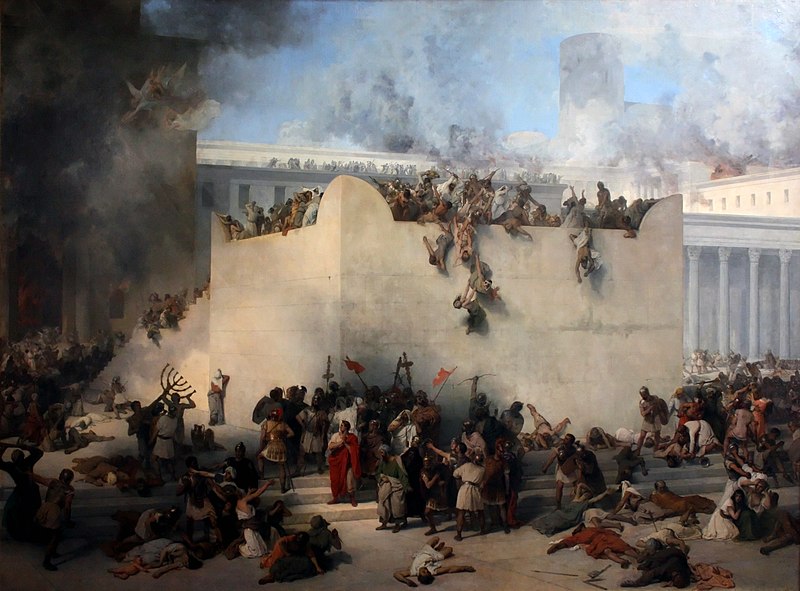
Jewish tradition holds that the ninth of Av (Tisha B'Av) was the same date on which the First Temple was destroyed by the Babylonians in 586 BCE — a coincidence that rabbinic literature invested with profound theological meaning. The Mishnah (Ta'anit 4.6) lists five catastrophes that occurred on Tisha B'Av, making it the saddest day in the Jewish calendar. To this day, observant Jews fast for 25 hours on Tisha B'Av, sit on low chairs as mourners, and read the Book of Lamentations.
Whether Titus genuinely tried to spare the Temple, as Josephus claims, or whether the destruction was deliberate, remains debated. The Roman historian Sulpicius Severus, apparently drawing on the lost portion of Tacitus's Histories, records that Titus ordered the Temple destroyed to eradicate both Judaism and Christianity at their root. Some modern scholars, including Martin Goodman of Oxford, have argued that this alternative account may be closer to the truth, and that Josephus whitewashed his patron's responsibility.
The Arch of Titus Verified
Standing at the eastern end of the Roman Forum, the Arch of Titus was erected around 81 CE by the Emperor Domitian to commemorate his brother Titus's conquest of Jerusalem. Its interior relief panels provide the most important Roman visual record of the Jewish Temple.
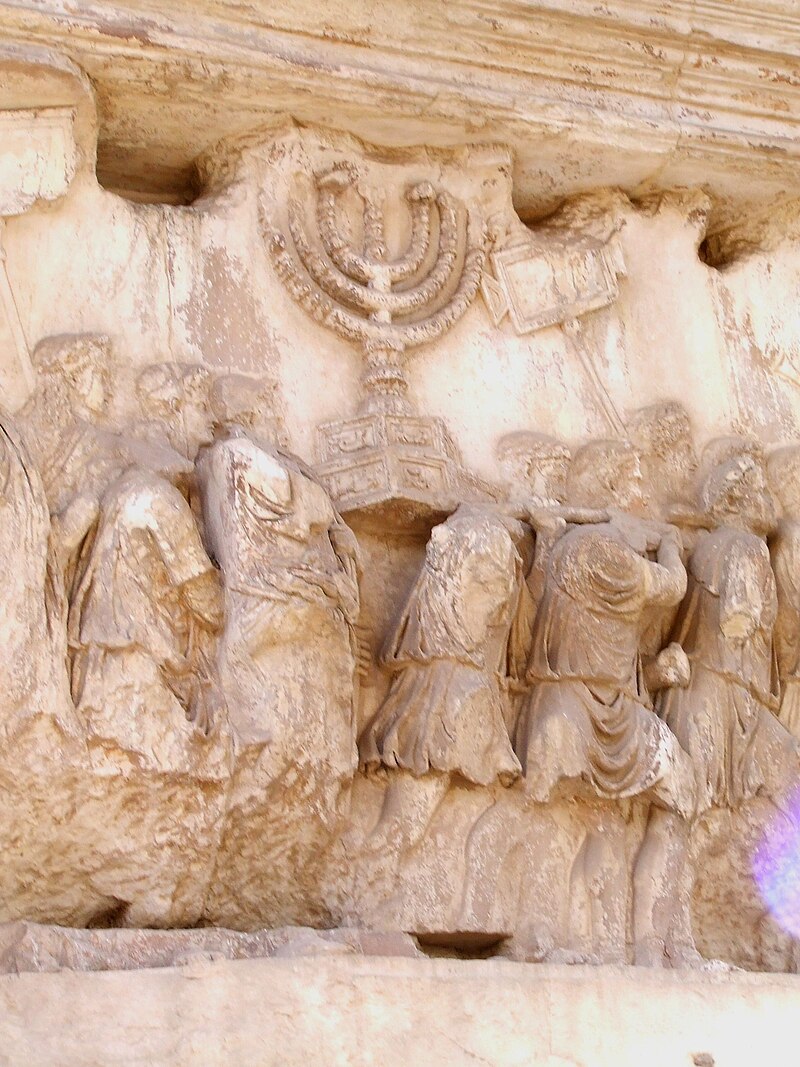
The south panel depicts Roman soldiers carrying spoils from the Temple in triumphal procession: the seven-branched menorah (the candelabrum), the silver trumpets, and the table of showbread. The soldiers wear laurel wreaths and carry placards identifying their conquests. The north panel shows Titus riding in a chariot, crowned by the goddess Victoria.
The menorah relief on the Arch of Titus became one of the most recognized symbols in Jewish history. Its depiction informed the design of the emblem of the modern State of Israel. In recent years, advanced imaging by Steven Fine of Yeshiva University and the Arch of Titus Digital Restoration Project has revealed traces of original paint on the relief — the menorah was colored golden yellow, confirming ancient descriptions of the gold-plated menorah.
For centuries, Jewish tradition held that Jews in Rome would not walk beneath the Arch, viewing it as a monument to Jewish humiliation. In 1948, following the declaration of Israeli independence, a procession of Roman Jews reportedly marched through the Arch in the opposite direction from the triumphal route, symbolically reversing the defeat.
The Western Wall as Remnant Debated
The Western Wall (HaKotel HaMa'aravi) is the most sacred site in Judaism where Jews are permitted to pray. However, its precise religious status has evolved over the centuries. The wall is not a remnant of the Temple itself but a retaining wall of the expanded Temple Mount platform built by Herod the Great. Some scholars have debated whether its sanctity derives from its proximity to the Temple's location (the kedusha of the site) or from accumulated centuries of prayer and pilgrimage.
The Midrash (Shemot Rabbah 2.2) records a tradition that the Divine Presence (Shekhinah) never departed from the Western Wall. However, during the Ottoman period (16th–19th centuries), the wall was a narrow alley just 28 meters long, and access was often restricted. The large plaza that exists today was created in June 1967, when Israel demolished the Mughrabi Quarter following the Six-Day War — an action that remains politically and morally contested.
Archaeological excavations along the full length of the Western Wall, including the Western Wall Tunnels opened to the public in 1996, have revealed the complete extent of Herod's construction — extending 488 meters from the southwestern corner to the northwestern corner. The tunnel tour passes the "Master Course," a single stone estimated at 570 tons — one of the heaviest objects ever lifted by human beings in the ancient world.
Masada: Archaeology and Narrative Debated
Masada, the clifftop fortress overlooking the Dead Sea, has become one of the most potent symbols in Israeli national identity — and one of the most debated archaeological sites in the world.
According to Josephus (Jewish War 7.252–406), a group of 960 Jewish Sicarii rebels held Masada from 66 to 73 CE (or 74 CE — the date is uncertain). When the Roman Tenth Legion, under the command of Flavius Silva, finally breached the walls using a massive siege ramp built by Jewish slaves, the defenders chose mass suicide rather than capture. Eleazar ben Ya'ir delivered two speeches persuading his followers that death was preferable to slavery. Men killed their families, ten men were chosen by lot to kill the others, one killed the remaining nine, and the last man set fire to the palace and fell on his own sword. Two women and five children survived by hiding in a cistern.
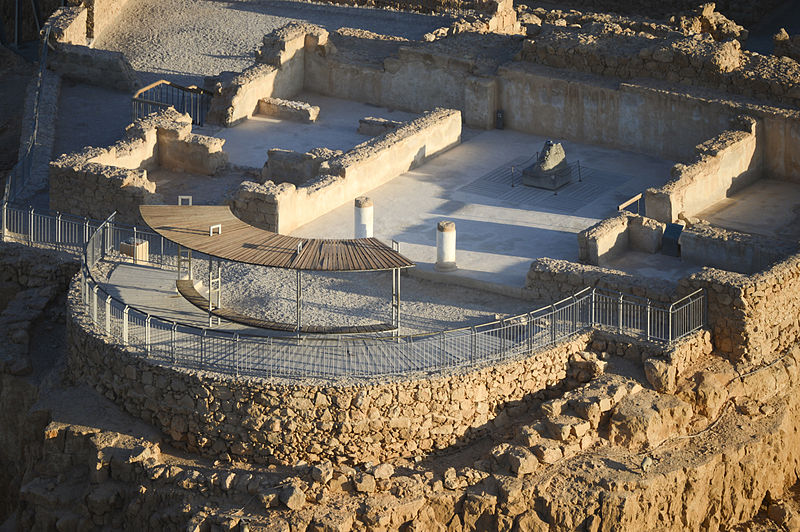
Yigael Yadin's celebrated excavation (1963–1965), conducted with thousands of volunteers from around the world, uncovered remarkable finds: Herod's palaces with their frescoes and mosaics, a synagogue (one of the oldest ever found), ritual baths, storerooms, and — most dramatically — 11 inscribed pottery sherds (ostraca) bearing names, which Yadin identified as the lots used in the suicide pact. He also found skeletal remains in a cave on the southern cliff face, which he identified as the rebels' bones and arranged a state military funeral.
However, subsequent scholarship has challenged nearly every aspect of Yadin's narrative. The anthropologist Joe Zias and forensic experts have argued that the skeletal remains included pig bones and may represent Roman-period burials, not rebel casualties. The ostraca with names could have served any administrative purpose. The archaeological evidence for a massive fire is limited. And Josephus's account — the sole source for the mass suicide — is suspected of literary embellishment, drawing on Roman rhetorical conventions about noble death. Nachman Ben-Yehuda's sociological study The Masada Myth (1995) demonstrated how the narrative was consciously constructed in the 20th century to serve Zionist ideological needs.
Today, Masada is a UNESCO World Heritage Site. The Roman siege ramp and camps remain the best-preserved examples of Roman siege warfare in the world, regardless of what happened inside the fortress.
The Bar Kokhba Revolt Verified
The final Jewish revolt against Rome erupted in 132 CE, led by Shimon bar Koseva, whom Rabbi Akiva reportedly called "Bar Kokhba" — "Son of the Star" — applying the messianic prophecy of Numbers 24:17 ("A star shall come out of Jacob"). The revolt was triggered by Emperor Hadrian's decision to build a pagan city, Aelia Capitolina, on the ruins of Jerusalem, and possibly by a ban on circumcision.
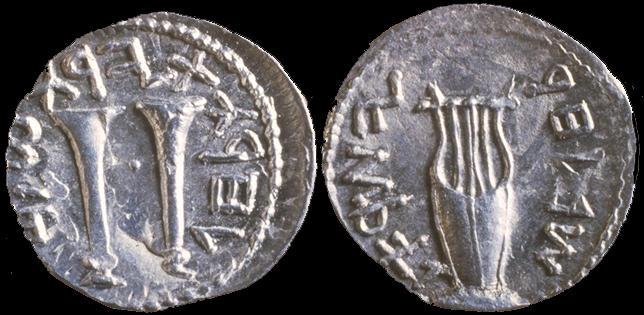
The revolt was initially successful. Bar Kokhba established an independent Jewish state that lasted approximately three years, minting coins inscribed "Year One of the Redemption of Israel" and "For the Freedom of Jerusalem." His administration was organized enough to issue land leases, collect taxes, and enforce Sabbath observance. Roman casualties were severe — the XXII Deiotariana Legion may have been entirely destroyed, and Hadrian reportedly omitted the customary formula "I and the legions are in health" in his report to the Senate.
The most dramatic evidence of Bar Kokhba comes from the Cave of Letters in Nahal Hever, near the Dead Sea, discovered by Yigael Yadin in 1960–1961. Inside the cave, Yadin found a bundle of letters written by Bar Kokhba himself — military orders demanding supplies, threatening subordinates, and instructing that the lulav and etrog be delivered for the Sukkot festival, showing that religious observance continued even during the revolt. The letters, written in Hebrew, Aramaic, and Greek, are now in the Israel Museum. The cave also contained personal possessions — keys, mirrors, sandals, a woman's jewelry — left by refugees who died there, likely of starvation.
Hadrian's Aelia Capitolina and the End of Jewish Jerusalem Verified
After crushing the Bar Kokhba revolt in 135 CE with devastating force, Hadrian implemented a program designed to erase Jewish connection to the land. Jerusalem was rebuilt as a Roman colony named Aelia Capitolina (combining Hadrian's family name, Aelius, with the Capitoline Triad of Roman gods). A temple to Jupiter was erected on the Temple Mount, and a temple to Venus was built at the site Christians identified as Golgotha (later the Church of the Holy Sepulchre). Jews were banned from entering the city except on Tisha B'Av, when they were permitted to mourn at the ruins.
The province of Judea was renamed Syria Palaestina — combining it with the Syrian province and applying the name of the ancient Philistines, Israel's historical enemies, in what many scholars interpret as a deliberate act of cultural erasure. Cassius Dio (Roman History 69.12–14) reports that 580,000 Jews were killed in the revolt, 50 fortified towns destroyed, and 985 villages razed — figures that, even if exaggerated, indicate catastrophic depopulation.
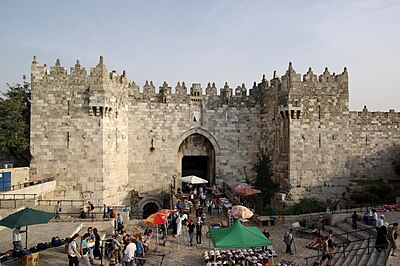
Archaeological evidence of Hadrian's Aelia Capitolina includes the Ecce Homo Arch (once thought to be Pilate's praetorium, now identified as part of Hadrian's triumphal entrance), the Roman pavement beneath the Sisters of Zion Convent (part of the forum), and the Damascus Gate, which in its lower courses preserves a Hadrianic gate structure with a column base visible through a modern excavation window — this is the origin of the Arabic name for Damascus Gate, Bab al-Amud ("Gate of the Column").
The Theological Impact of Destruction Tradition
The destruction of the Second Temple in 70 CE presented Judaism with its most profound theological crisis. The Temple had been the center of Jewish worship, the place where God's presence dwelled on earth, and the locus of the sacrificial system prescribed in the Torah. Its loss demanded fundamental reimagination.
The Talmud records the anguish in a famous passage (Berakhot 32b): "Since the day the Temple was destroyed, the gates of prayer have been locked." Yet in the same breath, it insists that the gates of tears were never locked — that sincere prayer still reaches heaven. This dialectic of loss and hope became the defining theological posture of Rabbinic Judaism.
Rabbi Yohanan ben Zakkai, according to tradition (Avot de-Rabbi Natan 4), encountered his student Rabbi Joshua weeping at the Temple ruins. "Woe to us," Joshua said, "for the place where the sins of Israel were atoned is destroyed." Ben Zakkai replied: "We have another atonement as effective as this — acts of loving-kindness (gemilut chasadim), as it is written, 'For I desire mercy, not sacrifice'" (Hosea 6:6). This exchange encapsulates the revolutionary theological move: Torah study, prayer, and ethical action replaced animal sacrifice as the primary means of serving God.
The rabbis also developed the concept that the study of the sacrificial laws was equivalent to performing the sacrifices themselves (Menachot 110a). The liturgy was restructured to correspond to the Temple service schedule — the Shacharit (morning), Mincha (afternoon), and Ma'ariv (evening) prayers replacing the daily offerings. The Passover seder was created as a home-based ritual replacing the Temple paschal sacrifice, transforming a priestly ritual into a family experience. These innovations ensured Judaism's survival as a portable, text-centered religion that could thrive without a central sanctuary.
Between the Revolts: The Transformation Debated
The period between the destruction of 70 CE and the Bar Kokhba revolt of 132 CE was a time of intense transformation. The academy at Yavneh, established by Rabban Yohanan ben Zakkai with Roman permission, became the new center of Jewish authority. The Sanhedrin was reconstituted there, and the process of defining the biblical canon, standardizing liturgy, and codifying oral traditions began.
The extent of what was accomplished at Yavneh remains debated. The notion of a "Council of Yavneh" that formally closed the biblical canon has been challenged by scholars like Jack Lewis and Sid Leiman, who argue that the canonization process was more gradual than the traditional account suggests. The discussions at Yavneh may have addressed specific disputed books — Ecclesiastes, Song of Songs, Esther — rather than establishing the entire canon de novo.
The Fiscus Judaicus and Its Humiliations Verified
After the destruction of the Temple, Vespasian imposed the fiscus Judaicus — a tax of two drachmas per year on every Jew in the Roman Empire, regardless of age or sex. This tax was a deliberate humiliation: it replaced the half-shekel Temple tax that Jews had voluntarily contributed to the Jerusalem Temple and redirected it to the Temple of Jupiter Capitolinus in Rome. The message was unmistakable — the God of Israel had been defeated, and the tribute that once sustained His house would now fund the worship of Rome's chief deity.
The tax was collected with varying degrees of rigor. Under Domitian (r. 81–96 CE), enforcement was notoriously aggressive — Suetonius records that men were physically examined in public to determine whether they were circumcised and therefore liable. Under Nerva (r. 96–98 CE), the worst abuses were curtailed, and coins were minted proclaiming Fisci Judaici calumnia sublata — "the injustice of the Jewish tax has been removed." The tax itself, however, persisted until at least the mid-2nd century CE.
Archaeological evidence for the fiscus Judaicus includes tax receipts on papyri found in Egypt (Oxyrhynchus and other sites), which record payments by named Jewish individuals — providing a documentary record of Jewish communities in Roman Egypt during this period.
What is clear is that the rabbis who gathered at Yavneh laid the foundations for a Judaism that could survive without the Temple, without political sovereignty, and without a territorial center. This was perhaps the most remarkable act of religious reinvention in human history — and it ensured that Judaism would endure through two millennia of exile, persecution, and dispersion.
The Coins of Revolt Verified
Both the Great Revolt and the Bar Kokhba revolt produced distinctive coinage that serves as primary archaeological evidence for the events.
Great Revolt coins (66–70 CE): The rebels minted silver shekels and half-shekels — the first Jewish silver coinage since the Hasmonean period — bearing Hebrew inscriptions such as "Shekel of Israel," "Jerusalem the Holy," and dates ("Year Two," "Year Three" of the revolt). The obverse typically shows a chalice (perhaps the Temple's incense cup), and the reverse a branch with three pomegranates. These coins deliberately invoked the Temple cult and national sovereignty. They are found in excavations throughout Jerusalem and Judea and are held in major numismatic collections worldwide.
Bar Kokhba coins (132–135 CE): Bar Kokhba's administration minted coins by overstruck existing Roman coins — literally erasing the emperor's image and replacing it with Jewish symbols. The new designs featured the Temple facade, the lulav and etrog, a lyre, grape clusters, and palm branches. Inscriptions read "Shimon" (Bar Kokhba's first name), "For the Freedom of Jerusalem," and "Year One (or Two) of the Redemption of Israel." The overstruck Roman coins beneath are sometimes still partially visible — a powerful material metaphor for the act of liberation.
The Bar Kokhba coins are among the most sought-after ancient Jewish coins. A hoard of 120 silver tetradrachms from the revolt, found in a cave near Hebron, is now in the Israel Museum. Individual specimens regularly appear at major auction houses.
The Dead Sea Refugees Verified
The caves along the western shore of the Dead Sea served as places of refuge during both revolts. In addition to the Cave of Letters (Bar Kokhba period), other caves have yielded dramatic finds:
The Cave of Horror (Nahal Hever): Named for the skeletal remains of approximately 40 men, women, and children found inside — refugees from the Bar Kokhba revolt who died of starvation rather than surrender to the Romans. A Roman siege camp is visible on the cliff above, evidence that the Romans waited patiently for the cave's inhabitants to perish.
Wadi Murabba'at: Caves in this wadi yielded documents from the Bar Kokhba period, including a letter signed by Bar Kokhba himself and biblical manuscripts in Hebrew and Greek. A spectacular find was a nearly complete scroll of the Minor Prophets in Hebrew, closely matching the later Masoretic text.
These caves, accessible only by dangerous cliff paths, testify to the desperation of the final stages of both revolts and preserve an extraordinarily intimate record of individuals caught in catastrophe.
Roman Commemoration of Victory Verified
Rome celebrated the destruction of Jerusalem with extraordinary thoroughness. Beyond the Arch of Titus, the Flavian dynasty's commemorative program included:
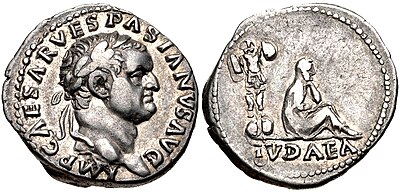
-
Coins: Vespasian and Titus issued a series of coins with the legend IVDAEA CAPTA ("Judea Captured") showing a mourning Jewish woman seated beneath a palm tree, with a Roman soldier standing over her. These coins were minted in gold, silver, and bronze across multiple Roman mints and circulated throughout the empire. They are among the most common Roman imperial coins and can be found in virtually every major numismatic collection.
-
The Temple of Peace (Templum Pacis): Built by Vespasian in the Roman Forum (71–75 CE), this complex housed the spoils of the Jewish War, including the golden menorah and the silver trumpets. Fragments of the Severan-era Marble Plan of Rome (Forma Urbis Romae) show the layout of this complex, and recent excavations by the Italian archaeological authorities have uncovered portions of the original flooring.
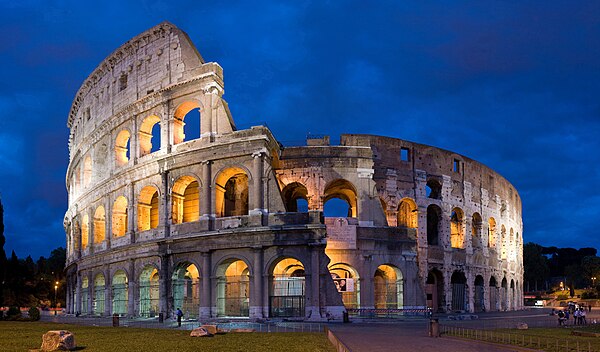
- The Flavian Amphitheatre (Colosseum): Ancient sources report that Jewish war captives were among the slave laborers who built the Colosseum, and that the spoils of the Jewish War helped finance its construction. A recently discovered and reconstructed inscription from the Colosseum appears to confirm that the building was funded ex manubiis — from the spoils of war.
The Fate of the Temple Treasures Debated
What happened to the Temple's sacred vessels after 70 CE has fascinated historians and treasure hunters for centuries. The Arch of Titus shows the menorah and other objects being carried in triumph through Rome. Josephus reports that the Temple treasures were deposited in Vespasian's Temple of Peace (Templum Pacis) in the Roman Forum.
After that, the trail grows cold. The Byzantine historian Procopius (6th century CE) claimed that the Vandal king Genseric looted the treasures from Rome in 455 CE and brought them to Carthage, and that the Byzantine general Belisarius recovered them in 534 CE and brought them to Constantinople. A Jewish advisor reportedly warned the emperor Justinian that the treasures were cursed and should be returned to Jerusalem. Procopius says they were sent to Christian churches in Jerusalem.
Whether any of these accounts is accurate remains unknown. Periodic claims of discovery — including a recent theory that the treasures lie beneath the Vatican — have no archaeological support. The menorah depicted on the Arch of Titus remains, for now, the last verifiable image of the Temple's most sacred furnishing.
The destruction of the Temple did not end Jewish life in the land of Israel. Major Jewish communities persisted in Galilee, producing the great academies of Tiberias, Sepphoris, and Caesarea. These communities would produce the Mishnah, the Jerusalem Talmud, and a rich tradition of synagogue art and liturgical poetry. But the center of gravity was shifting eastward — toward Babylonia, where the largest and most creative Jewish community in the world was about to produce the Babylonian Talmud, the text that would shape Judaism for the next fifteen hundred years.
Locations in This Chapter
Loading map...