Part 4: Second Temple · 539–516 BCE
13.Return and Rebuilding
Cyrus Cylinder, Second Temple
16 min read
Return and Rebuilding
The End of Exile
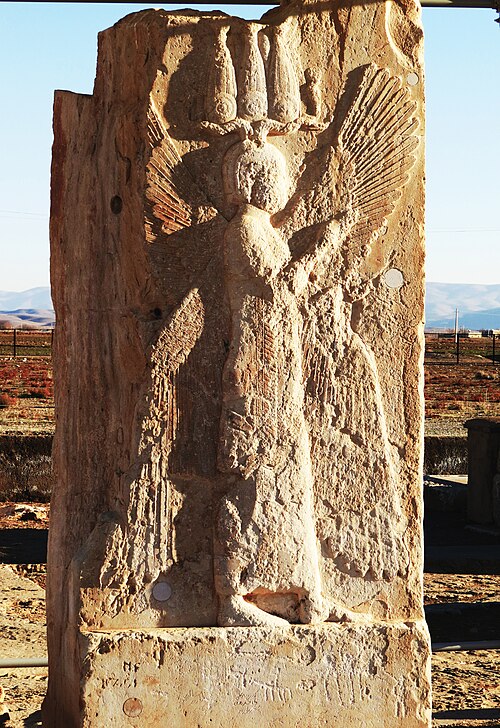
In October 539 BCE, the army of Cyrus II of Persia entered Babylon without a battle. The greatest city in the ancient world, capital of the empire that had destroyed Jerusalem, fell almost silently. Within months, the exiled Judahites received permission to return home and rebuild their temple. It was, from the perspective of the biblical authors, nothing less than a second exodus.
The Cyrus Cylinder
VerifiedIn 1879, Hormuzd Rassam, an Assyrian-born archaeologist working for the British Museum, discovered a barrel-shaped clay cylinder at the site of ancient Babylon. The Cyrus Cylinder, now one of the most famous objects in the British Museum (Room 52), is inscribed in Akkadian cuneiform and describes Cyrus's conquest of Babylon and his subsequent policies.
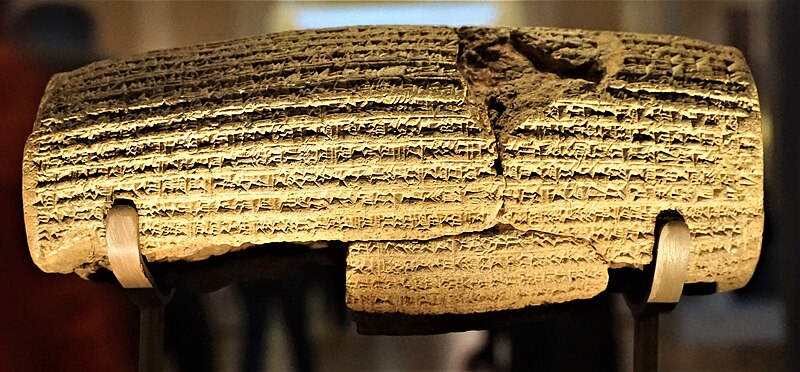
The cylinder presents Cyrus as chosen by Marduk, the chief god of Babylon, to overthrow the impious king Nabonidus, who had neglected Marduk's cult. Cyrus declares: "I returned the images of the gods, who had resided there, to their places... I gathered all their people and returned them to their settlements." He describes restoring sanctuaries and repatriating displaced peoples throughout his empire.
VerifiedThe Cyrus Cylinder does not mention the Jews or Jerusalem specifically. It is a general policy statement, reflecting the Persian approach to imperial governance: rather than the Assyrian and Babylonian practice of deportation and cultural destruction, the Persians pursued a policy of religious tolerance and administrative decentralization. Subject peoples were permitted --- even encouraged --- to maintain their ancestral cults, on the assumption that a god who was properly worshipped would bless the empire.
The cylinder has sometimes been called "the first declaration of human rights," a characterization promoted by the Shah of Iran in the 1960s and 1970s. This is anachronistic --- Cyrus was an imperial conqueror, not a liberal philosopher --- but the Persian policy of religious tolerance was genuinely remarkable by ancient standards and had enormous consequences for Jewish history.
DebatedThe cylinder's general policy of restoring cults and repatriating peoples provides the context for the specific decree regarding the Jews recorded in the Bible. Whether the biblical version of the decree (preserved in two forms: a Hebrew proclamation in Ezra 1:2-4 and an Aramaic memorandum in Ezra 6:3-5) is authentic or a later composition remains debated. The Hebrew version, which has Cyrus acknowledge YHWH as "the God of heaven," is widely considered to reflect later Jewish theological editing. The Aramaic version, which reads more like an administrative memorandum specifying the temple's dimensions and construction materials, is generally regarded as more likely to preserve an authentic Persian document, though perhaps not verbatim.
The Return Under Zerubbabel
TraditionThe Book of Ezra describes the return of exiles to Jerusalem under the leadership of two figures: Zerubbabel son of Shealtiel (a grandson of the exiled King Jehoiachin, and thus a member of the Davidic dynasty) and Joshua (Jeshua) son of Jozadak, the high priest. Ezra 2 provides a detailed census of the returnees: 42,360 persons, plus 7,337 servants and 200 singers, along with horses, mules, camels, and donkeys.
The returning exiles are described as restoring the altar of burnt offering on its original site, celebrating the Festival of Booths (Sukkot), and beginning the reconstruction of the temple. When the foundation was laid, the older priests and Levites who remembered the First Temple wept --- whether from joy or from disappointment at the new temple's modest scale, the text is ambiguous (Ezra 3:12-13).
DebatedThe historical reliability of the return narrative is debated on several fronts. The number 42,360 is suspiciously round and possibly inflated. Whether a mass return happened in a single wave or over decades (or whether most exiles simply stayed in Babylon, where they had established comfortable lives) is unclear. The archaeological evidence for the early Persian period in Judah (known as the province of Yehud) shows a very small, poor population --- perhaps 10,000 to 15,000 people in the entire province, centered on Jerusalem and its immediate environs.
The names Zerubbabel ("seed of Babylon") and Sheshbazzar (who appears in Ezra 1:8-11 as the initial leader, possibly identical with Shenazzar in 1 Chronicles 3:18) are Babylonian-style names, consistent with individuals raised in the diaspora. The brief prominence and sudden disappearance of Zerubbabel from the narrative has generated much speculation: the prophets Haggai and Zechariah appear to invest messianic hopes in him ("I will take you, O Zerubbabel my servant... and make you like a signet ring; for I have chosen you," Haggai 2:23), but he vanishes without explanation. Was he removed by the Persians for being too politically dangerous as a Davidic heir? The text does not say, and the silence is telling.
Construction of the Second Temple
TraditionThe construction of the Second Temple was plagued by delays. According to Ezra 4, the "adversaries of Judah and Benjamin" --- identified as the peoples settled in the former northern kingdom by the Assyrians --- offered to help build the temple, but their offer was refused. In retaliation, they "hired counselors against them to frustrate their purpose all the days of King Cyrus of Persia and until the reign of King Darius of Persia" (Ezra 4:5). Construction halted for approximately sixteen years.
The prophets Haggai and Zechariah urged the community to resume building. Haggai, prophesying in 520 BCE, rebuked the people for living in "paneled houses" while the temple lay in ruins: "Is it a time for you yourselves to live in your paneled houses, while this house lies in ruins?... You have sown much, and harvested little; you eat, but you never have enough; you drink, but you never have your fill" (Haggai 1:4, 6). Zechariah offered visionary encouragement: a lampstand flanked by two olive trees (representing Zerubbabel and Joshua), a vision of the high priest Joshua cleansed and re-robed, and the promise that the temple would be completed "not by might, nor by power, but by my spirit, says the Lord of hosts" (Zechariah 4:6).
DebatedThe Second Temple was completed and dedicated in 515 BCE, the sixth year of Darius I, according to Ezra 6:15. The date is generally accepted by scholars, though the precise circumstances of the dedication are less certain. The temple was modest compared to the elaborate descriptions of Solomon's temple --- the Talmud (Yoma 21b) later lists five things present in the First Temple but absent from the Second: the Ark of the Covenant, the sacred fire, the Shekinah (divine presence), the Holy Spirit, and the Urim and Thummim.
Verified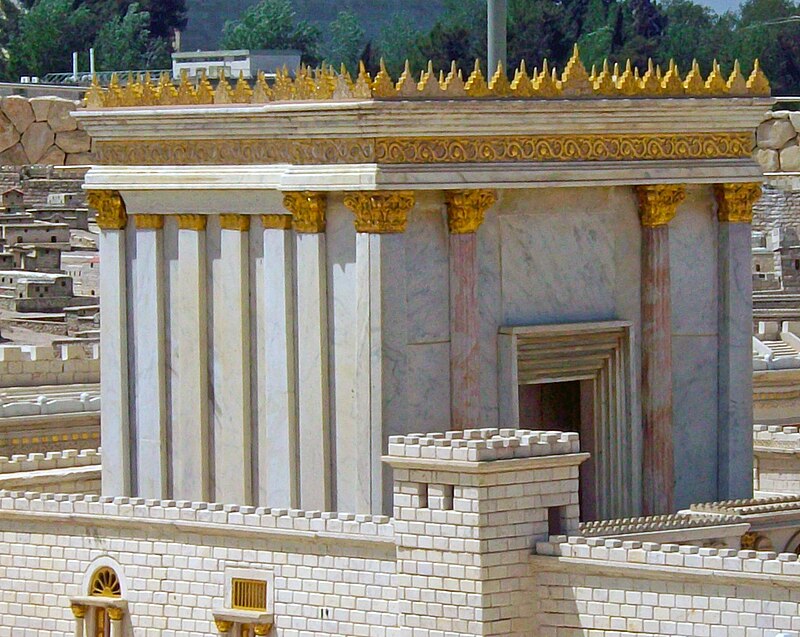
No archaeological remains of the Second Temple in its early form have been identified, for the same reason that no remains of the First Temple have been found: the Temple Mount has never been excavated. However, Yehud coins (tiny silver coins minted in the Persian province of Yehud, some bearing the word YHD in paleo-Hebrew or Aramaic script and depicting owls, lilies, or divine figures) provide evidence of the province's administrative existence. Some Yehud coins depict a seated figure that may represent a deity, raising questions about the iconographic practices of the early Second Temple community.
Ezra and Nehemiah: The Restoration Community
TraditionThe Books of Ezra and Nehemiah describe the consolidation of the restored community in two phases: Ezra's mission focused on religious reform and the Torah, while Nehemiah's focused on physical reconstruction and political organization.
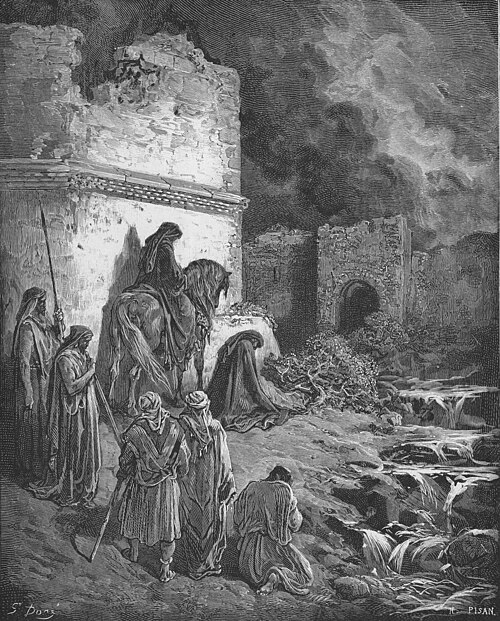
Nehemiah, described as a cupbearer to the Persian King Artaxerxes (either Artaxerxes I, reigned 465--424 BCE, or Artaxerxes II, reigned 404--358 BCE --- the chronology is disputed), received permission to return to Jerusalem and rebuild its walls. His memoir, one of the rare first-person accounts in the Hebrew Bible, describes the nighttime inspection of the ruined walls, the organization of work crews, and the constant threats from Sanballat the Horonite (governor of Samaria), Tobiah the Ammonite, and Geshem the Arab.
VerifiedSanballat, Tobiah, and Geshem --- Nehemiah's three antagonists --- are all attested in extrabiblical sources. Sanballat appears in the Elephantine Papyri as the governor of Samaria. The "Tobiad" family is well-attested in later sources, and a family tomb at Araq el-Emir in Jordan bears the name "Tobiah" in Hebrew. Geshem (or Gashmu) is mentioned in a silver vessel inscription from Tell el-Maskhuta in Egypt, identifying him as "king of Qedar" (an Arabian tribal confederation). These external attestations are remarkable confirmations of the historical setting described in Nehemiah.
VerifiedNehemiah's wall has been a subject of archaeological investigation. Excavations in the City of David have revealed a narrow wall from the Persian period, far smaller in scope than the pre-exilic fortifications. This is consistent with the reduced size of post-exilic Jerusalem: the Western Hill, which had been incorporated into the city under Hezekiah, was apparently not reoccupied in the Persian period. The post-exilic city was essentially the old City of David and the Temple Mount --- a much smaller area than the pre-destruction city.
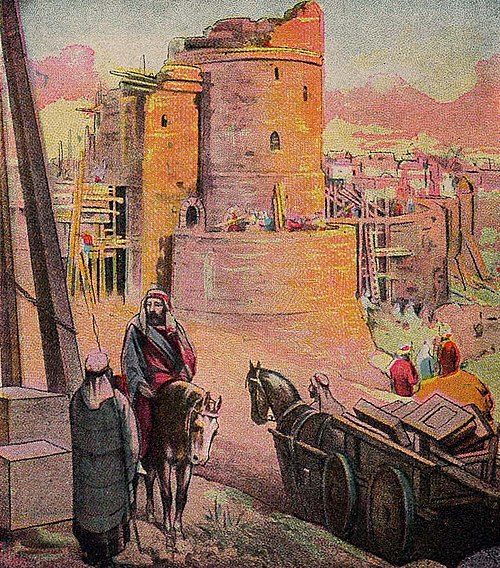
Eilat Mazar claimed to have identified a section of Nehemiah's wall in her City of David excavations, though the dating and identification have been challenged. The fragmentary nature of the remains reflects the reality: the returned community was small and poor, rebuilding on a modest scale.
Ezra and the Torah
TraditionEzra the scribe is presented in the biblical text as a pivotal figure who brought "the book of the law of Moses" from Babylon to Jerusalem and read it publicly to the assembled community (Nehemiah 8). The people wept upon hearing the law, celebrated the Festival of Booths in a way that "had not been done since the days of Joshua son of Nun" (Nehemiah 8:17), confessed their sins, and entered into a covenant to observe the Torah.
Ezra also enforced the controversial policy of dissolving marriages between Jewish men and non-Jewish women (Ezra 9--10), a measure that defined the community's boundaries in ethnic and religious terms. This policy has been variously interpreted as an act of religious purification, an assertion of communal identity under threat, or an exclusionary program by a returning elite against those who had remained in the land and intermarried.
DebatedThe question of what exactly Ezra brought from Babylon --- and whether this event represents the promulgation of the Torah in something like its final form --- is one of the most significant questions in biblical studies. The traditional view, held within Judaism, is that Ezra essentially re-established the Torah of Moses. Critical scholars offer a range of views: some see Ezra as promulgating the completed Pentateuch (the five books of Moses), others a specific legal code (perhaps the Priestly source or the Holiness Code of Leviticus 17--26), and still others question whether the Ezra narrative is historical at all.
The compilation and editing of the Torah during the exilic and early post-exilic period is widely accepted in some form, even among scholars who disagree on the details. The classic Documentary Hypothesis, associated with Julius Wellhausen (1878), proposed four main sources: J (Yahwist, using the name YHWH), E (Elohist, using Elohim), D (Deuteronomist, the core of Deuteronomy), and P (Priestly source, including Leviticus and the tabernacle narratives). While the Documentary Hypothesis in its classic form has been significantly modified by recent scholarship, the basic insight that the Torah was compiled from multiple sources and reached its final form in the post-exilic period remains a mainstream position.
The Development of Synagogue Worship
DebatedThe destruction of the First Temple in 586 BCE created a crisis: how could YHWH be worshipped without a temple, without an altar, without sacrifices, in a foreign land? The traditional answer is that the synagogue emerged as an alternative institution during the Babylonian exile --- a place of prayer, scripture reading, and community gathering that did not require animal sacrifice.
This is plausible but difficult to prove. The earliest archaeological evidence for synagogue buildings dates to the third century BCE in Egypt (inscriptions mentioning a proseuche, or "prayer house," at Schedia near Alexandria) and the first century BCE in the land of Israel (the Theodotus inscription from Jerusalem, the synagogues at Gamla and Masada). The institution may have existed in a less formalized way --- gatherings in homes or public spaces --- long before purpose-built structures appeared.
Ezekiel, a priest among the Babylonian exiles, records that "the elders of Israel came to me and sat before me" (Ezekiel 14:1, 20:1), which may describe an early form of synagogue-like assembly. Psalm 137's question --- "How shall we sing the Lord's song in a foreign land?" --- implies that some form of communal worship was practiced in exile, even if it felt inadequate.
The significance of the synagogue's development cannot be overstated. It made Judaism portable. For the first time, a religion centered on a specific place (Jerusalem, the temple) could be practiced anywhere. This innovation, whether it originated in Babylon or developed later, was what made Judaism viable as a diaspora religion and ultimately made possible the survival of Jewish identity through two millennia without a temple or a state.
The Elephantine Papyri Revisited
Verified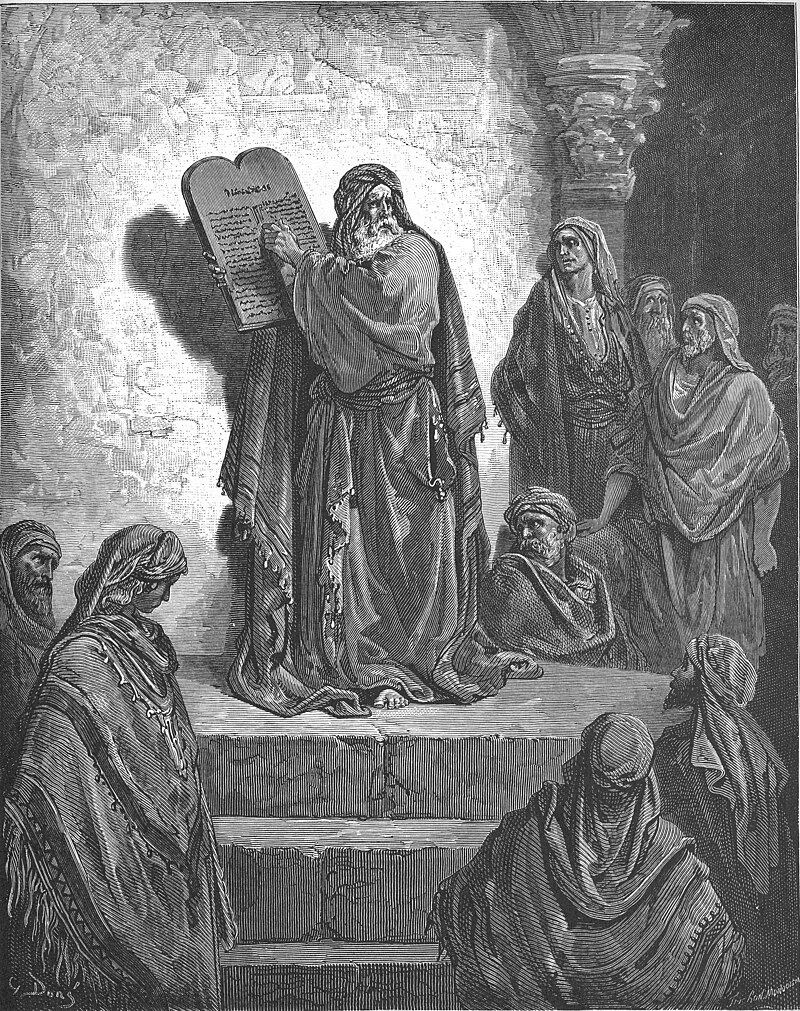
The Jewish military colony at Elephantine Island in Upper Egypt (discussed in the previous chapter) provides a fascinating counterpoint to the Jerusalem-centered narrative of Ezra-Nehemiah. The Elephantine community had its own temple to YHW, its own priesthood, and its own religious calendar. When the temple was destroyed by Egyptian rivals in 410 BCE, the community wrote to both the governor of Judah (Bagohi) and the sons of Sanballat in Samaria for help in rebuilding it.
VerifiedThe Elephantine Papyri (now divided between the Egyptian Museum in Berlin, the Brooklyn Museum, and other collections) include marriage contracts, property deeds, letters, and legal documents. They reveal a community that observed Passover and the Sabbath but also participated in a polytheistic religious culture, swearing oaths by Egyptian gods and worshipping alongside YHW the deities Anat-Bethel, Ashim-Bethel, and Herem-Bethel.
This diversity of practice stands in stark contrast to the exclusivist Torah-centered Judaism promoted by Ezra and Nehemiah. It suggests that in the fifth century BCE, "Judaism" was not a single, unified religion but a spectrum of practices, ranging from the strict monotheism and Torah observance of the Jerusalem establishment to the syncretistic piety of frontier communities like Elephantine.
DebatedThe relationship between these different forms of Judaism --- Babylonian, Palestinian, Egyptian --- and the eventual triumph of the Jerusalem-centered, Torah-based model is one of the great questions of the Second Temple period. The Elephantine community disappears from the historical record after the late fifth century BCE. Whether it was absorbed, dispersed, or simply stopped producing documents that survived, we do not know.
The Persian Period: An Age of Quiet Transformation
VerifiedThe Persian period (539--332 BCE) is often overlooked in favor of the more dramatic eras before and after it, but its transformations were profound. Under Persian rule, the province of Yehud was a tiny administrative unit --- perhaps 20 by 25 miles --- governed by a Persian-appointed governor (sometimes Jewish, sometimes not) and supervised by the satrap of the larger province "Beyond the River" (Transeuphrates).
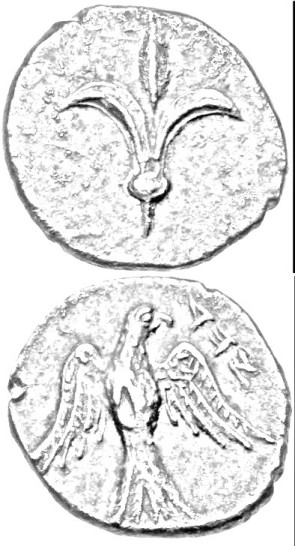
The material culture of the period is modest. Excavated sites show small, poor settlements. The economic base was agricultural. The population was sparse. Yehud coins and seal impressions (bullae) stamped YHD provide evidence of provincial administration, but the overall picture is one of a marginal community on the edge of a vast empire.
DebatedYet this quiet period saw transformations of immense consequence:
- The Torah was compiled in something close to its final form
- The prophetic canon was largely completed
- Synagogue worship began to develop
- Aramaic replaced Hebrew as the everyday language (Hebrew continued as a literary and liturgical language)
- The concept of a Jewish diaspora --- communities living permanently outside the land of Israel while maintaining a connection to Jerusalem --- became a permanent feature of Jewish life
- The authority of the priesthood and the temple establishment grew, laying the foundation for the theocratic structure of Second Temple society
- The seeds of sectarian division were planted, as different groups competed over the correct interpretation of the Torah and the proper form of worship
These developments, largely invisible in the archaeological record and only partially recorded in the biblical text, made possible everything that followed: the resistance to Hellenism, the Maccabean revolt, the flowering of Second Temple Judaism, and ultimately the emergence of Rabbinic Judaism and Christianity.
Conclusion
The return from exile and the rebuilding of the temple were not the dramatic restoration that the prophets had envisioned. There was no new David, no renewed kingdom, no miraculous transformation of the land. Zerubbabel disappeared; the temple was modest; the community was small and poor and constantly under threat from neighbors and imperial politics.
And yet the period from 539 to 516 BCE --- from the Cyrus Cylinder to the dedication of the Second Temple --- represents one of the most consequential transitions in human religious history. A religion of temple and territory began its transformation into a religion of text and community. The Torah emerged as the center of Jewish life. The synagogue began its long history. The diaspora became permanent. Judaism became portable, adaptable, and indestructible --- not because it was powerful, but because its essence had been distilled to something that could be carried anywhere: a book, a community, a covenant, a memory.
The stones of the Second Temple were humble. The scroll of the Torah was eternal.
Locations in This Chapter
Loading map...