Part 4: Second Temple · 332–63 BCE
14.Hellenistic Period & Maccabees
Hanukkah origins, Dead Sea Scrolls
21 min read
The Hellenistic Period and the Maccabees
When East Met West
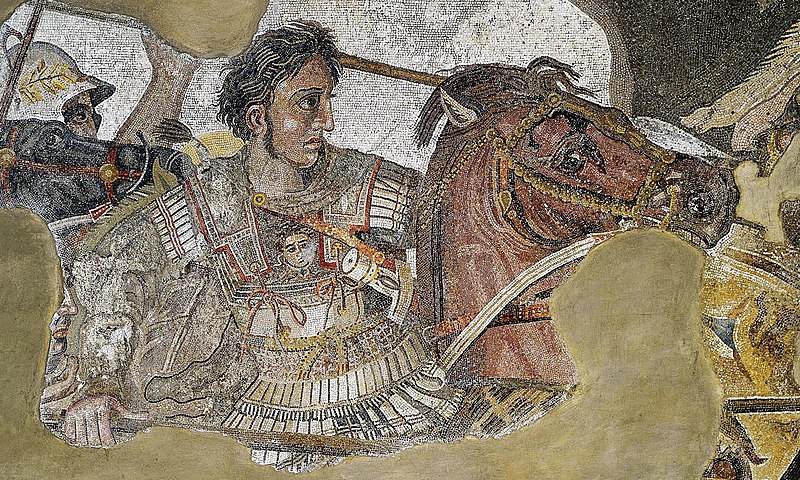
In 332 BCE, Alexander the Great marched south from his conquest of Tyre and entered the land of Israel. The Persian Empire, which had governed the Jewish community for over two centuries, was collapsing. A new world was being born --- one dominated by Greek language, Greek culture, and Greek ideas. The encounter between Judaism and Hellenism would prove to be one of the most creative and violent collisions in the history of civilization, producing the festival of Hanukkah, the Dead Sea Scrolls, the Septuagint, apocalyptic literature, and the sectarian divisions that defined Judaism in the age of Jesus.
Alexander's Conquest
VerifiedAlexander III of Macedon conquered the Persian Empire with astonishing speed between 334 and 323 BCE. After defeating Darius III at Issus (333 BCE) and besieging Tyre and Gaza (332 BCE), he moved through the Levant on his way to Egypt. The specifics of his encounter with Jerusalem are poorly attested in contemporary sources.
TraditionJosephus, the first-century Jewish historian, tells a famous story (Antiquities 11.8.4-5): when Alexander approached Jerusalem, the high priest Jaddua went out to meet him in his priestly vestments, accompanied by a procession of priests in white. Alexander, recognizing the high priest from a dream, prostrated himself before the divine name on the priestly miter, entered the temple, and offered sacrifices. He granted the Jews the right to live according to their ancestral laws and exempted them from tribute in sabbatical years.
DebatedMost historians regard Josephus's account as legendary, shaped by later Jewish apologetics seeking to establish a positive relationship between Judaism and Hellenistic culture. The Talmud (Yoma 69a) preserves a similar but distinct version. What is historically certain is that Alexander's conquest brought the land of Israel into the Hellenistic world, and that the transition from Persian to Macedonian rule was relatively smooth for the Jewish community. The province of Yehud continued to function under the authority of the high priest, now answerable to Greek-speaking overlords instead of Aramaic-speaking ones.
Ptolemaic and Seleucid Rule
VerifiedWhen Alexander died in Babylon in 323 BCE at the age of thirty-two, his empire was divided among his generals (the Diadochi) after decades of war. Judea fell first under the control of Ptolemy I Soter, who ruled Egypt, and remained under Ptolemaic control for over a century (301--198 BCE). The Ptolemaic period was generally favorable for the Jews. The Jewish community in Alexandria, Egypt's new capital, grew to become the largest Jewish diaspora community in the ancient world, eventually numbering perhaps 150,000 to 200,000 people.
VerifiedIn 198 BCE, the Seleucid king Antiochus III ("the Great"), ruling from Antioch in Syria, defeated the Ptolemaic army at the Battle of Panion (Banias, at the foot of Mount Hermon) and gained control of the land of Israel. Josephus records that Antiochus III initially treated the Jews favorably, confirming their right to live according to their ancestral laws and providing funds for the temple.
The Zenon Papyri, a large collection of Greek administrative documents from the mid-third century BCE found at Philadelphia (Faiyum) in Egypt, provide glimpses of Ptolemaic administration in Palestine, including references to Jewish communities, trade in olive oil and grain, and the activities of the powerful Tobiad family --- descendants of Nehemiah's enemy Tobiah --- who served as tax collectors and power brokers under Ptolemaic rule.
Hellenization: Attraction and Resistance
DebatedThe spread of Greek culture throughout the Near East --- Hellenization --- was not simply an imposition by conquerors but a complex, multidirectional process. Greek became the international language of commerce, administration, and intellectual life. Greek cities (poleis) were founded or refounded throughout the region, with gymnasiums, theaters, temples, and agoras. Greek philosophical ideas, artistic styles, and social customs permeated local cultures.
Many Jews found aspects of Hellenism attractive. The wealthy Tobiad family embraced Greek customs and political alliances. Jason (originally Joshua), who became high priest around 175 BCE, petitioned Antiochus IV for permission to convert Jerusalem into a Greek polis and to build a gymnasium --- a request that was granted and that deeply alarmed traditionalists. The gymnasium, built near the Temple Mount, was particularly offensive because Greek athletics were performed in the nude, and some Jewish men even attempted to reverse their circumcisions (epispasm) to avoid ridicule (1 Maccabees 1:15).
TraditionThe book of 1 Maccabees presents the conflict as a stark binary: "In those days certain renegades came out from Israel and misled many, saying, 'Let us go and make a covenant with the Gentiles around us, for since we separated from them many disasters have come upon us'" (1 Maccabees 1:11). The "renegades" are Jewish Hellenizers who abandon the covenant for the allure of Greek culture.
DebatedModern scholars see a more nuanced picture. Hellenization was not an all-or-nothing proposition. Many Jews adopted Greek language and cultural forms while maintaining their core religious identity. The Septuagint translation of the Torah into Greek (see below) was itself an act of cultural engagement, not cultural surrender. The question was not whether to engage with Greek culture but how much and on what terms. The crisis that led to the Maccabean revolt was triggered not by Hellenization in general but by a specific political and religious provocation: the actions of Antiochus IV Epiphanes.
Antiochus IV and the Desecration of the Temple
Verified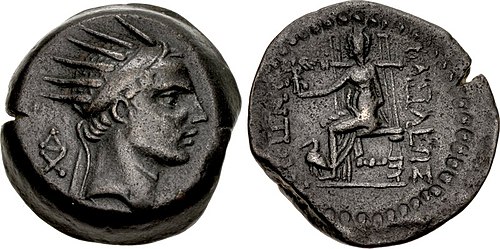
Antiochus IV Epiphanes (reigned 175--164 BCE) is one of the great villains of Jewish history. His epithet "Epiphanes" means "God Manifest"; his detractors called him "Epimanes" --- "the Madman." His policies toward the Jews were shaped by a combination of political calculation (he needed money and political stability to confront the growing threat of Rome), internal Jewish factionalism (rival claimants to the high priesthood courted his support with ever-larger bribes), and perhaps genuine ideological conviction about the superiority of Greek religion.
VerifiedThe crisis escalated rapidly. In 169 BCE, returning from a campaign in Egypt, Antiochus plundered the Jerusalem temple, carrying off the golden altar, the menorah, and other sacred vessels --- an event confirmed by both 1 Maccabees 1:20-24 and the account of the Greek historian Polybius. In 167 BCE, he went further: he outlawed Torah observance, prohibited circumcision and Sabbath keeping under penalty of death, ordered the destruction of Torah scrolls, and --- most shockingly --- set up an altar to Zeus Olympios in the Jerusalem temple and sacrificed swine on it.
TraditionThe book of Daniel, widely understood by critical scholars as composed during this crisis (though set in the Babylonian period), describes the desecration as the "abomination of desolation" (shiqquts meshomem, Daniel 11:31, 12:11). Second Maccabees provides graphic accounts of the persecution: mothers who circumcised their children were put to death with the infants hung around their necks; an elderly scribe named Eleazar was tortured to death for refusing to eat pork; seven brothers and their mother were martyred one by one for refusing to violate the Torah (2 Maccabees 6--7).
DebatedThe exact nature of the "abomination of desolation" is debated. Was the altar dedicated to Zeus Olympios, to the Syrian deity Baal Shamin (identified with Zeus by the Greeks), or to some syncretic form of YHWH-as-Zeus? Some scholars suggest that Antiochus was not trying to eliminate Judaism but to universalize it --- to reinterpret YHWH as a manifestation of the supreme Greek deity. If so, the strategy was spectacularly miscalculated.
The Maccabean Revolt
TraditionThe revolt began in the village of Modein (Modi'in), in the foothills between the coastal plain and the Judean highlands. According to 1 Maccabees, when a Seleucid officer arrived to enforce the new religious decrees and ordered the villagers to sacrifice to the Greek gods, an elderly priest named Mattathias killed both a compliant Jew who stepped forward to sacrifice and the Seleucid officer himself. Mattathias and his five sons --- John, Simon, Judah, Eleazar, and Jonathan --- fled to the hills and launched a guerrilla war.
Tradition
Judah, nicknamed "Maccabee" (possibly meaning "the Hammer"), emerged as the military leader after Mattathias's death in 166 BCE. Despite being vastly outnumbered, the Maccabees won a series of stunning victories against Seleucid armies in the hill country, using terrain and guerrilla tactics to offset the enemy's professional soldiers and war elephants. The battles at Beth-horon, Emmaus, and Beth-zur (all described in 1 Maccabees 3--4) became legendary.
In December 164 BCE --- the 25th of Kislev, three years to the day after the desecration --- Judah and his forces recaptured the temple, cleansed it, built a new altar, and rededicated it. "And they celebrated the dedication of the altar for eight days... So they celebrated the dedication of the altar at its proper season, just as they had celebrated its desecration" (1 Maccabees 4:56, 59). This is the origin of Hanukkah.
Hanukkah: Military Victory or Miracle of Oil?
VerifiedThe earliest accounts of Hanukkah --- in 1 and 2 Maccabees (composed in the late second and early first centuries BCE) --- describe a military-political event: the rededication of the temple after its liberation. First Maccabees presents a straightforward celebration of the Maccabean victory. Second Maccabees adds the theme of fire: Nehemiah had preserved sacred fire from the First Temple, and the rededication involved a miraculous kindling of the altar fire (2 Maccabees 1:18-36, 10:1-8). Both books frame Hanukkah as an eight-day festival modeled on Sukkot (the Festival of Booths), which the community had been unable to celebrate during the persecution.
TraditionThe famous story of the miracle of oil --- that a single cruse of pure olive oil, sufficient for only one day, miraculously burned for eight days in the rededicated temple --- does not appear in any source until the Babylonian Talmud (Shabbat 21b), composed roughly 600 years after the events. The Talmud poses the question "Mai Hanukkah?" ("What is Hanukkah?") and answers with the oil miracle, largely ignoring the military dimension.
DebatedWhy did the rabbis shift the emphasis from military victory to divine miracle? Several explanations have been proposed. By the time the Talmud was composed, the Hasmonean dynasty (the Maccabees' descendants) had become associated with corruption, civil war, and the invitation of Roman intervention. The rabbis may have been reluctant to celebrate a military victory achieved by a priestly family that had usurped the kingship. Additionally, the rabbinic emphasis on divine intervention rather than human military prowess reflected their broader theology of dependence on God rather than on political power --- a theology forged in the crucible of the failed revolts against Rome in 66--73 and 132--135 CE.
The historical Hanukkah was a celebration of military liberation and religious rededication. The rabbinic Hanukkah was a celebration of divine providence. Both meanings coexist in the festival as celebrated today.
The Hasmonean Dynasty
VerifiedThe Maccabean revolt succeeded beyond anyone's expectations, but its aftermath was complex and often ugly. Judah Maccabee died in battle at Elasa in 160 BCE. His brother Jonathan took over the leadership and, through shrewd diplomacy, maneuvering between rival Seleucid claimants, obtained the high priesthood in 152 BCE --- a stunning development, since the Maccabees were not of the Zadokite priestly line that had traditionally held the office.
Simon, the last surviving brother, achieved formal independence from the Seleucids in 142 BCE. He was acclaimed as high priest, military commander, and ethnarch (political leader) "until a trustworthy prophet should arise" (1 Maccabees 14:41) --- a formula that acknowledged the irregular nature of Hasmonean authority while deferring the question to an indefinite future.
VerifiedSimon's son John Hyrcanus I (reigned 134--104 BCE) expanded the Hasmonean state dramatically, conquering Idumea (Edom) to the south and forcibly converting its population to Judaism, destroying the Samaritan temple on Mount Gerizim, and extending control into Transjordan. His sons Aristobulus I (who first took the title "king") and Alexander Jannaeus (reigned 103--76 BCE) further expanded the territory to approximate the extent of the Davidic kingdom.
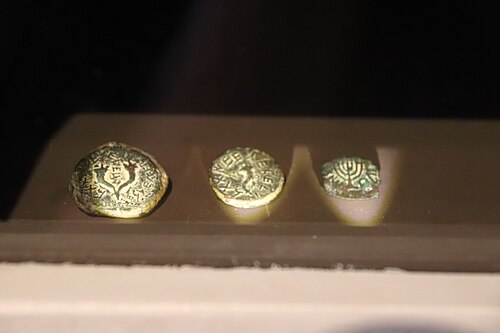
Hasmonean coins, minted in Hebrew and Greek, provide tangible evidence of the dynasty's claims. Early coins bear only the high-priestly title; later coins add the royal title, reflecting the dynasty's growing political ambitions.
DebatedThe Hasmonean combination of kingship and high priesthood was deeply controversial. The traditional separation of royal (Davidic) and priestly (Zadokite) authority had deep roots in Israelite tradition. The Hasmoneans were neither Davidic nor Zadokite; their assumption of both offices offended multiple constituencies. This opposition was a driving force behind the emergence of Jewish sectarianism.
The Dead Sea Scrolls
VerifiedIn late 1946 or early 1947 (the exact date is uncertain), a Bedouin shepherd named Muhammed edh-Dhib, searching for a lost goat near the northwestern shore of the Dead Sea, threw a rock into a cave and heard the sound of breaking pottery. Inside he found clay jars containing ancient scrolls wrapped in linen. This accidental discovery at Qumran would prove to be the greatest manuscript find of the twentieth century.
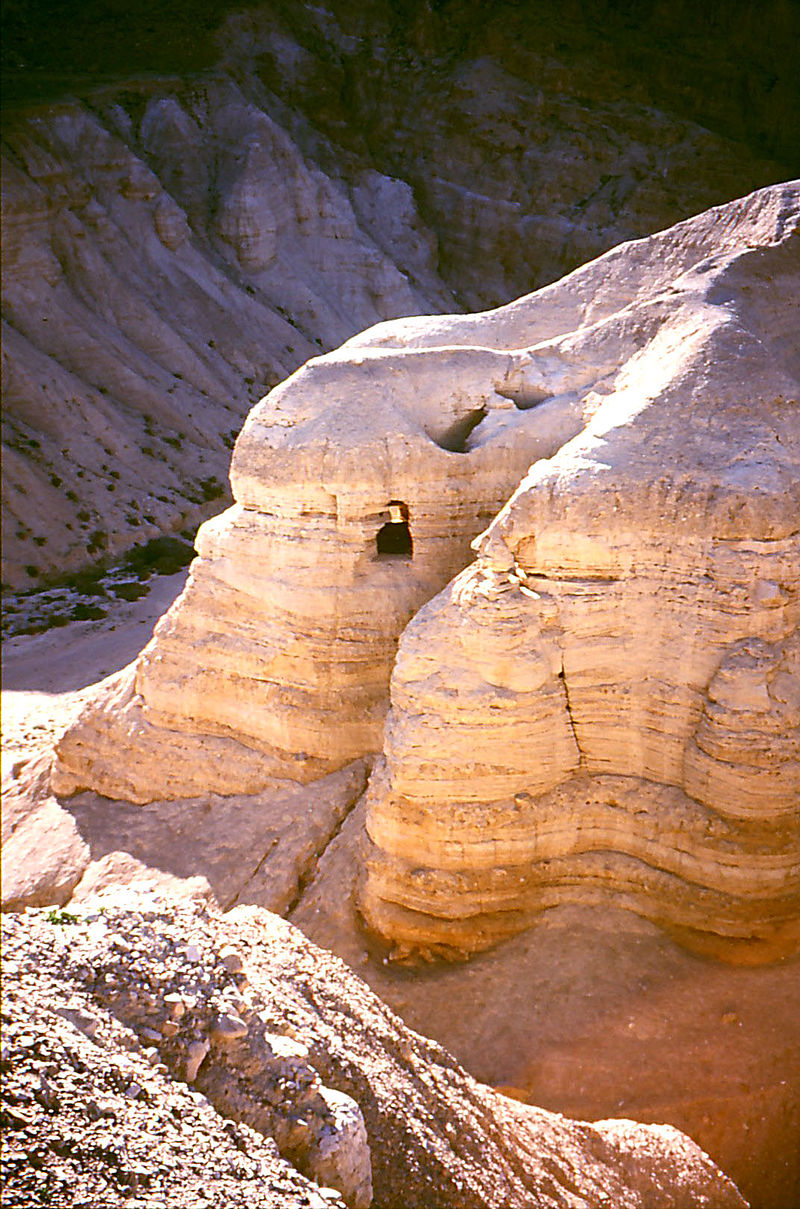
Between 1947 and 1956, eleven caves in the vicinity of Qumran yielded approximately 900 manuscripts, ranging from nearly complete scrolls to tiny fragments. The texts, written primarily in Hebrew and Aramaic with a few in Greek, date from the third century BCE to the first century CE. They include:
Verified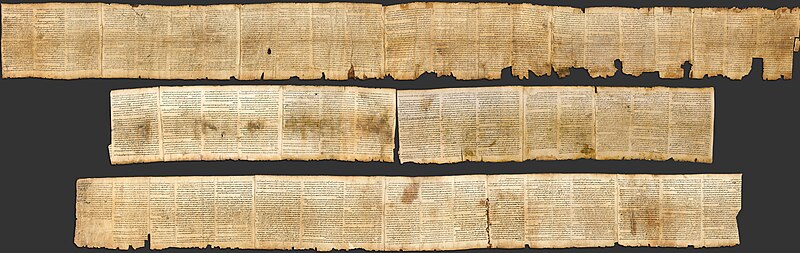
Biblical manuscripts: Every book of the Hebrew Bible except Esther is represented, with the most popular being Psalms (36 copies), Deuteronomy (33 copies), and Isaiah (21 copies). The Great Isaiah Scroll (1QIsa-a), a complete copy of the Book of Isaiah measuring 7.3 meters (24 feet) in length, is one of the most famous manuscripts in the world, now displayed at the Shrine of the Book in the Israel Museum, Jerusalem. Dating to approximately 125 BCE, it is roughly a thousand years older than the oldest previously known Hebrew manuscript of Isaiah (the Masoretic Text tradition, dating to the tenth century CE). Remarkably, the text is substantially identical to the later Masoretic version, demonstrating the extraordinary fidelity of Jewish scribal transmission over a millennium.
Sectarian documents: The Community Rule (1QS), the War Scroll (1QM), the Thanksgiving Hymns (1QH), the Damascus Document (CD), and the Temple Scroll (11QT) reveal the beliefs and practices of the community that produced or collected the scrolls. They describe a group that had separated from mainstream Jewish society, lived in strict communal discipline under a figure called the Teacher of Righteousness, expected an imminent apocalyptic war between the "Sons of Light" and the "Sons of Darkness," and opposed the Jerusalem priesthood, which they regarded as illegitimate.
Apocryphal and pseudepigraphal texts: Works such as the Book of Jubilees, 1 Enoch, the Genesis Apocryphon, and various previously unknown texts (such as the Songs of the Sabbath Sacrifice) reveal the rich literary creativity of Second Temple Judaism.
DebatedThe identity of the Qumran community remains debated, though the majority of scholars identify them with the Essenes described by Josephus, Philo, and Pliny the Elder. The site of Qumran itself --- excavated by Roland de Vaux from 1951 to 1956 --- includes communal dining areas, ritual baths (miqva'ot), a scriptorium (where scrolls may have been copied), and a cemetery with over 1,100 burials. De Vaux identified Qumran as the Essene community center, a view that has been challenged by alternative theories: that the site was a villa, a fortification, a pottery factory, or something else entirely. The connection between the scrolls in the caves and the settlement at Qumran is probable but not proven beyond doubt.
The Septuagint
TraditionAccording to the Letter of Aristeas (a pseudepigraphal work from the second century BCE), the Egyptian king Ptolemy II Philadelphus (reigned 285--246 BCE) commissioned a Greek translation of the Jewish Torah for the Library of Alexandria. Seventy-two elders were sent from Jerusalem (six from each tribe), and they completed the translation in exactly seventy-two days on the island of Pharos. The translation was read aloud and declared to be accurate and authoritative. This is the origin of the name "Septuagint" (from the Latin septuaginta, "seventy," abbreviated LXX).
VerifiedWhile the legendary details of the Letter of Aristeas are not historical, the core fact is confirmed: the Torah was translated into Greek in Ptolemaic Alexandria, probably in the third century BCE, making it the first translation of a major religious text into another language. The remaining books of the Hebrew Bible were translated over the following centuries, and the complete Greek Bible (the Septuagint) also included books not found in the Hebrew canon --- Sirach, Wisdom of Solomon, Judith, Tobit, the Maccabean books, and others.
DebatedThe Septuagint is enormously important for biblical studies. In some passages, it preserves readings that differ from the Masoretic Text, and the Dead Sea Scrolls have confirmed that some of these differences reflect variant Hebrew originals rather than translation errors. The book of Jeremiah in the Septuagint, for example, is approximately one-eighth shorter than in the Masoretic Text, and a Hebrew scroll from Qumran (4QJer-b) matches the shorter Septuagint version. This demonstrates that multiple editions of biblical books circulated simultaneously in the Second Temple period --- the biblical text was more fluid than later tradition acknowledged.
The Septuagint became the Bible of Greek-speaking Jews throughout the Mediterranean and later the primary Old Testament of early Christianity. This fact eventually led to its rejection by some Jewish authorities, who regarded it as tainted by Christian appropriation --- though this rejection was neither immediate nor universal.
The Book of Daniel and Apocalyptic Vision
DebatedThe Book of Daniel, set during the Babylonian exile (sixth century BCE), is widely dated by critical scholars to 167--164 BCE, during the persecution of Antiochus IV. The evidence includes: the book's detailed and accurate description of events under Antiochus (Daniel 11, which traces Hellenistic history from Alexander through the Seleucid-Ptolemaic wars with remarkable precision) and its sudden loss of accuracy after 164 BCE (the predicted death of Antiochus in Daniel 11:40-45 does not match the actual circumstances of his death); its inclusion in the "Writings" (Ketuvim) rather than the "Prophets" (Nevi'im) in the Hebrew canon, suggesting it was composed after the prophetic corpus was closed; and its use of Persian and Greek loanwords inconsistent with a sixth-century composition.
TraditionJewish and Christian tradition, by contrast, has long maintained that Daniel was a genuine sixth-century prophet. His visions of four successive empires (Babylon, Persia, Greece, and Rome, in the traditional interpretation), the "Son of Man" coming on the clouds of heaven (Daniel 7:13-14), and the resurrection of the dead (Daniel 12:2) became foundational texts for messianic expectation and eschatology.
DebatedDaniel is the primary example of "apocalyptic" literature in the Hebrew Bible --- a genre characterized by symbolic visions, angelic interpreters, cosmic warfare between good and evil, periodization of history, and expectation of imminent divine intervention. The apocalyptic worldview, which emerged in the third and second centuries BCE (as evidenced by 1 Enoch and other texts found at Qumran), represented a significant departure from earlier prophetic thought. While the prophets spoke of God acting within history, the apocalyptists looked for the end of history --- a final judgment, a new age, a radical transformation of the created order.
This apocalyptic sensibility, nourished by the crisis of Antiochus's persecution, would profoundly shape the Judaism of the late Second Temple period and provide the intellectual framework for early Christianity.
Sectarian Judaism: Pharisees, Sadducees, Essenes
VerifiedJosephus describes three main "philosophies" (haireseis) within Judaism: the Pharisees, the Sadducees, and the Essenes. (He mentions a fourth --- the Zealots or the followers of Judas the Galilean --- as a later development.) These groups emerged during the Hasmonean period, shaped by disagreements over the proper interpretation of the Torah, the legitimacy of the Hasmonean priest-kings, and the correct response to Hellenism and foreign rule.
DebatedThe Pharisees believed in the authority of both the written Torah and the "oral Torah" --- a body of interpretive tradition transmitted from teacher to student. They accepted belief in the resurrection of the dead, angels, and divine providence operating alongside human free will. Josephus says they were popular with the common people. Their spiritual descendants were the rabbis who compiled the Mishnah and Talmud after the destruction of the Second Temple in 70 CE.
The Sadducees were associated with the priestly and aristocratic establishment. They accepted only the written Torah as authoritative, rejected belief in the resurrection and in the elaborate angelology and demonology of the Pharisees and Essenes, and emphasized human free will. They disappeared after the destruction of the temple, which eliminated the institutional base (the priestly cult) on which their authority depended.
The Essenes, if the identification with the Qumran community is correct, withdrew from mainstream society to live in strict purity and communal discipline. They practiced communal ownership of property, ritual immersion, communal meals, celibacy (at least in some groups), and intensive study of scripture. Their expectation of an imminent apocalyptic war and their development of a complex angelology mark them as deeply influenced by the apocalyptic tradition.
DebatedThese neat categories, derived primarily from Josephus, are almost certainly oversimplified. Jewish society in the late Second Temple period was far more diverse than a three-way division suggests. The Dead Sea Scrolls reveal at least one community with distinctive beliefs not fully captured by Josephus's description of the Essenes. Other groups --- the Samaritans, the Hellenizing aristocracy, various messianic movements, the am ha-aretz (common people of the land) --- complicate the picture further. Second Temple Judaism was not one thing but many, a ferment of competing visions of what it meant to be Israel.
Conclusion
The Hellenistic period, from Alexander's conquest in 332 BCE to Pompey's conquest in 63 BCE, was an era of transformation, crisis, and creativity unmatched in Jewish history until the modern period. Greek culture posed a challenge that could not be simply accepted or rejected but had to be engaged on multiple levels --- linguistic, philosophical, political, and religious.
The Maccabean revolt demonstrated that Judaism could resist assimilation by force of arms. The Septuagint demonstrated that it could engage with Greek culture on its own terms. The Dead Sea Scrolls demonstrated that the encounter produced not uniformity but diversity --- a proliferation of competing visions, interpretations, and communities. The Book of Daniel demonstrated that crisis could generate new theological categories --- apocalyptic expectation, resurrection, final judgment --- that would reshape religious imagination for millennia.
The stones bear witness: Hasmonean coins, Qumran ruins, scroll jars in desert caves. The scrolls speak in multiple voices: Maccabean triumphalism, Essene separatism, Pharisaic legalism, Sadducean conservatism, apocalyptic urgency. Together they testify to a Judaism in ferment --- not a monolith but a living argument, a tradition in perpetual dialogue with itself and with the world.
Locations in This Chapter
Loading map...