Part 7: Modern Era · 1897–1947
25.Zionism
Herzl, Balfour, British Mandate
20 min read
The Visionary of Vienna Verified
On a February day in 1896, a Viennese journalist and playwright named Theodor Herzl (1860–1904) published a slim pamphlet titled Der Judenstaat (The Jewish State). Its opening argument was stark: "The Jewish question still exists. It would be foolish to deny it." Antisemitism, Herzl argued, was not a relic that would fade with progress — it was a permanent feature of societies in which Jews lived as minorities. The only solution was a Jewish state, established through international diplomacy and mass migration.
Herzl was not the first to propose Jewish statehood. Rabbi Judah Alkalai (1798–1878) and Rabbi Zvi Hirsch Kalischer (1795–1874) had argued on religious grounds for Jewish settlement in the Land of Israel decades earlier. Moses Hess's Rome and Jerusalem (1862) had made the case on secular nationalist grounds. Leo Pinsker's Auto-Emancipation (1882), written in the wake of the Russian pogroms, had called for a Jewish homeland (without specifying Palestine). The Hovevei Zion (Lovers of Zion) movement, founded in 1884, had already organized small-scale settlement in Ottoman Palestine.
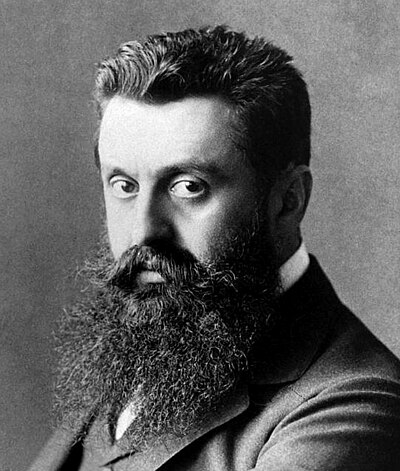
What Herzl brought was something new: a program for political action, a galvanizing personal charisma, and a capacity for operating on the international stage. He was, in many respects, an unlikely candidate. An assimilated Viennese Jew who barely knew Hebrew, who had once considered mass conversion as a solution to antisemitism, and who had little prior engagement with Jewish communal life — Herzl was transformed by events (the Dreyfus Affair prominent among them, though scholars debate its precise role) into a visionary who would reshape Jewish history.
The First Zionist Congress Verified
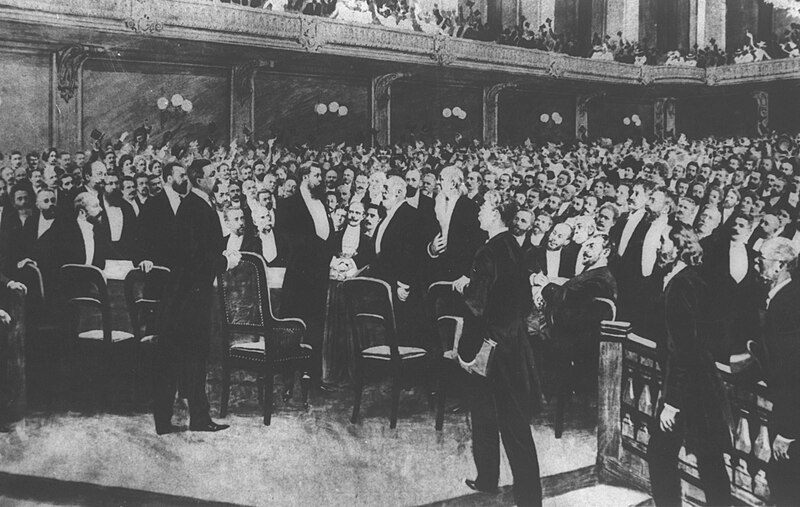
Herzl moved with extraordinary speed. On August 29–31, 1897, he convened the First Zionist Congress in the Stadtcasino in Basel, Switzerland. Originally planned for Munich, the congress was moved to Basel after German Jewish communal leaders — who feared Zionism would undermine their claims to German citizenship — protested vigorously.
Approximately 200 delegates attended, representing Jewish communities from across Europe and beyond. The congress adopted the "Basel Program," which declared: "Zionism aims at establishing for the Jewish people a publicly and legally assured home in Palestine." It created the institutional framework for the movement: the World Zionist Organization (WZO), with Herzl as president; a national fund for land purchase; and a bank to finance settlement.
After the congress, Herzl wrote in his diary an entry that has become legendary: "At Basel I founded the Jewish State. If I said this out loud today, I would be answered by universal laughter. In five years, perhaps, and certainly in fifty years, everyone will perceive it." Israel declared independence fifty-one years later.
The early Zionist movement was not monolithic. It encompassed political Zionists (who prioritized diplomatic recognition), practical Zionists (who emphasized settlement on the ground), cultural Zionists (led by Ahad Ha'am, who envisioned Palestine as a spiritual center rather than a mass-migration destination), religious Zionists (the Mizrachi movement, founded in 1902), and socialist Zionists (who combined nationalism with revolutionary politics). These internal divisions were often fierce and would shape the movement — and the state it created — for decades.
The Uganda Scheme Debated
The urgency of Jewish persecution drove Herzl to consider alternatives to Palestine. In 1903, the British government, through Colonial Secretary Joseph Chamberlain, offered Herzl a territory in British East Africa (in what is now Kenya, though it was commonly called the "Uganda Scheme") for Jewish settlement. Herzl, desperate to provide immediate refuge for Russian Jews after the Kishinev pogrom, presented the offer to the Sixth Zionist Congress in August 1903.
The proposal provoked a crisis. The Russian delegation, representing the very Jews Herzl sought to save, reacted with fury — Palestine or nothing. When the congress voted to send an investigative commission to East Africa (by 295 to 178, with 100 abstentions), the Russian delegates walked out in protest, some weeping. The East African proposal was eventually rejected by the Seventh Congress in 1905, after Herzl's death. But the episode revealed a fundamental tension in Zionism: was the movement primarily about saving Jewish bodies (in which case any territory would do) or about restoring the Jewish people to their ancestral homeland (in which case only Eretz Israel was acceptable)?
Herzl died on July 3, 1904, at the age of forty-four, of heart failure exacerbated by years of exhausting travel and diplomatic campaigning. He had not achieved his goal, but he had created the institutional infrastructure and the political vocabulary that would eventually produce a state. His remains were reinterred on Mount Herzl in Jerusalem in 1949, as he had requested in his will.
The Early Aliyah Waves Verified
Jewish immigration to Ottoman Palestine (and later British Mandatory Palestine) is conventionally divided into waves, or aliyot (singular aliyah, "ascent"):
The First Aliyah (1882–1903): Triggered by the Russian pogroms, approximately 25,000–35,000 Jews arrived in Palestine, mainly from the Russian Empire and Romania. They established agricultural settlements including Rishon LeZion (1882), Zikhron Ya'akov (1882), and Rosh Pinna (1882). Many of these early settlements survived only through the philanthropy of Baron Edmond de Rothschild of Paris, who invested over 70 million francs in the project. The settlers often had little agricultural experience, and relations with Arab neighbors were already complicated — a foretaste of conflicts to come.
The Second Aliyah (1904–1914): Approximately 35,000–40,000 immigrants arrived, many of them young idealists imbued with socialist and revolutionary fervor. This wave produced the kibbutz movement — Degania, the first kibbutz, was founded in 1910 on the southern shore of the Sea of Galilee — as well as the labor institutions (the Histadrut labor federation, founded in 1920) and the political leadership (David Ben-Gurion, Yitzhak Ben-Zvi, Berl Katznelson) that would dominate the Yishuv (the Jewish settlement) and the future state for decades.
The Third Aliyah (1919–1923): Approximately 35,000–40,000 immigrants arrived in the aftermath of World War I, the Balfour Declaration, and the establishment of the British Mandate. They expanded the kibbutz movement, built roads and infrastructure, and established new institutions.
The Fourth Aliyah (1924–1929): Approximately 67,000 immigrants, many of them middle-class Polish Jews driven by economic restrictions in Poland and the closing of American immigration, arrived. Many settled in cities, particularly Tel Aviv, which grew rapidly during this period.
The Fifth Aliyah (1929–1939): The most consequential wave, bringing approximately 250,000 immigrants, including a large number of German Jews fleeing Nazism after 1933. This wave included professionals, intellectuals, and capital that transformed the Yishuv's economy, culture, and institutional capacity.
The Balfour Declaration Verified
On November 2, 1917, British Foreign Secretary Arthur James Balfour sent a letter to Lord Walter Rothschild, a leader of the British Jewish community, declaring:
"His Majesty's Government view with favour the establishment in Palestine of a national home for the Jewish people, and will use their best endeavours to facilitate the achievement of this object, it being clearly understood that nothing shall be done which may prejudice the civil and religious rights of existing non-Jewish communities in Palestine, or the rights and political status enjoyed by Jews in any other country."
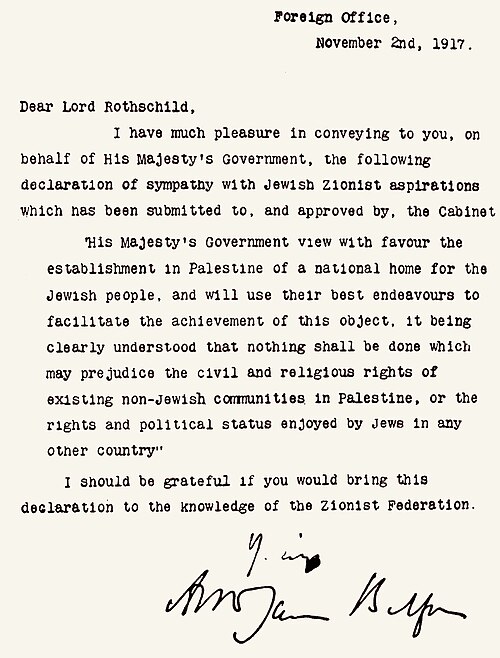
This sixty-seven-word sentence — drafted, debated, and revised over months by the British War Cabinet — became one of the most consequential diplomatic documents of the twentieth century. Its motivations were complex and debated by historians: sympathy for Zionism among key British officials (including Balfour himself and Prime Minister David Lloyd George, both influenced by Christian Zionist ideas); strategic calculations about winning Jewish support for the Allied war effort; 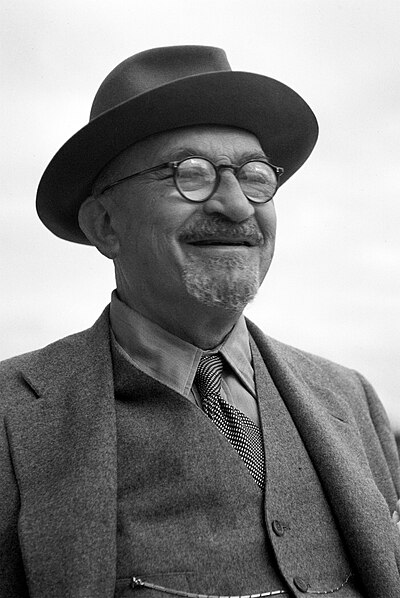
the lobbying of Chaim Weizmann, a brilliant chemist whose work on acetone production contributed to the British war effort and who had unparalleled access to the British establishment; and imperial ambitions for British influence in the postwar Middle East. Debated
The declaration's internal contradiction — promising a "national home" for Jews while pledging to protect the rights of the "non-Jewish communities" (who constituted approximately 90% of Palestine's population at the time) — would prove irreconcilable and remains at the heart of the Israeli-Palestinian conflict.
The British Mandate Verified
The League of Nations formally assigned the Palestine Mandate to Britain on July 24, 1922, incorporating the language of the Balfour Declaration into the mandate's terms. Britain was charged with facilitating Jewish immigration and settlement while maintaining order and protecting the rights of all inhabitants.
The Mandate period (1920–1948) was characterized by a three-way struggle among the British administration, the growing Jewish Yishuv, and the Arab population. Key developments include:
The building of the Yishuv: The Jewish community in Palestine created what amounted to a state-within-a-state. The Yishuv had its own elected assembly (Asefat ha-Nivharim), executive body (Va'ad Leumi), labor federation (Histadrut), underground military force (the Haganah, organized in 1920), educational system (including the Hebrew University of Jerusalem, founded in 1925, and the Technion in Haifa, founded in 1924), and a growing economy. By 1947, the Jewish population had grown from approximately 83,000 (11% of the total) in 1922 to approximately 630,000 (33%).
Arab opposition: The Arab population of Palestine opposed Jewish immigration with increasing intensity. Major outbreaks of violence occurred in 1920 (the Nebi Musa riots in Jerusalem), 1921 (the Jaffa riots), 1929 (the Hebron massacre, in which 67 Jews were killed and the ancient Jewish community of Hebron was destroyed), and 1936–1939 (the Arab Revolt, a sustained campaign of strikes, attacks, and guerrilla warfare against both the British and the Yishuv). The leadership of the Palestinian Arab national movement was dominated by Haj Amin al-Husseini, the Grand Mufti of Jerusalem, whose uncompromising opposition to Zionism and later collaboration with Nazi Germany discredited moderate Arab voices.
The Hebrew Revival Verified
One of the most remarkable cultural achievements of the Zionist movement was the revival of Hebrew as a spoken, everyday language — an accomplishment without parallel in linguistic history.
Hebrew had never entirely ceased to be used. It remained the language of prayer, scholarship, and correspondence among Jewish communities worldwide. But it had not been a vernacular — a language of marketplaces, bedrooms, and playgrounds — since roughly the second century CE.
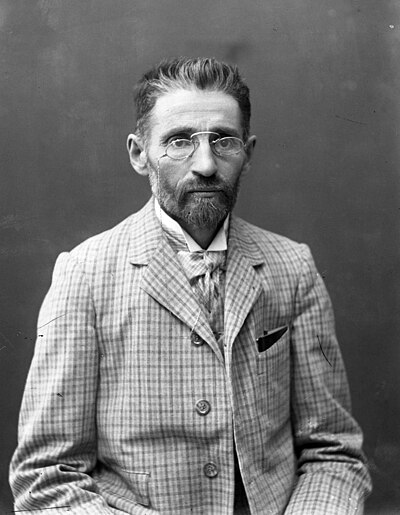
The driving force behind the revival was Eliezer Ben-Yehuda (1858–1922), born Eliezer Yitzhak Perlman in Lithuania, who arrived in Palestine in 1881 and embarked on a one-man campaign to make Hebrew the language of daily life. He and his wife Devorah raised their son, Ben-Zion (Itamar Ben-Avi), as the first native Hebrew speaker in modern times — reportedly refusing to allow the child to hear any other language, a practice that struck many contemporaries as fanatical.
Ben-Yehuda's monumental achievement was his Complete Dictionary of Ancient and Modern Hebrew, published in seventeen volumes between 1910 and 1959 (the final volumes were completed after his death by his second wife, Hemda, and his son). He coined or revived thousands of words needed for modern life — iton (newspaper), millon (dictionary), ofanayim (bicycle) — drawing on biblical, mishnaic, and medieval Hebrew roots.
The linguistic revolution was institutionalized through the Hebrew Language Committee (established 1890, later reconstituted as the Academy of the Hebrew Language in 1953) and, crucially, through the school system. The "Language War" of 1913, in which students and teachers at the Technion in Haifa protested against the use of German as the language of instruction, established Hebrew's supremacy in the Yishuv's educational institutions.
The White Papers and Partition Verified
As violence escalated, the British government issued a series of policy documents that progressively restricted the terms of the Mandate:
The Churchill White Paper (1922) clarified that the Balfour Declaration did not mean Palestine as a whole would become a Jewish state, and separated Transjordan (the territory east of the Jordan River) from the Mandate, prohibiting Jewish settlement there.
The Passfield White Paper (1930), issued after the 1929 riots, recommended restricting Jewish immigration and land purchase. Fierce Zionist lobbying led to its effective retraction by Prime Minister Ramsay MacDonald in a letter to Chaim Weizmann (the "MacDonald Letter" of 1931).
The Peel Commission Report (1937) was the first official proposal to partition Palestine into separate Jewish and Arab states. The commission, chaired by Lord William Peel, concluded that the Mandate was unworkable because Arab and Jewish aspirations were irreconcilable. It proposed a small Jewish state (approximately 20% of Palestine), a larger Arab state to be united with Transjordan, and a British-controlled corridor including Jerusalem. The Zionist leadership debated the proposal intensely — Ben-Gurion supported the principle of partition while rejecting the specific boundaries; the Arab leadership, led by Haj Amin al-Husseini, rejected it categorically.
The MacDonald White Paper (1939) — the most consequential — effectively reversed the Balfour Declaration. Issued on the eve of World War II, it limited Jewish immigration to 75,000 over five years (with further immigration subject to Arab consent), severely restricted Jewish land purchase, and envisioned an independent Palestinian state within ten years in which Jews would be a permanent minority. The White Paper was issued at precisely the moment when European Jews were most desperately seeking refuge, and its immigration restrictions would trap hundreds of thousands in Nazi-occupied Europe.
The Biltmore Conference and Its Aftermath Verified
By the early 1940s, the center of Zionist political activity had shifted from London to New York. In May 1942, an emergency Zionist conference was held at the Biltmore Hotel in Manhattan. Attended by 600 delegates and chaired by Chaim Weizmann, the conference adopted the "Biltmore Program," which for the first time explicitly demanded the establishment of a "Jewish Commonwealth" in Palestine — a significant escalation from the vaguer "national home" language of the Balfour Declaration.
David Ben-Gurion, who had effectively become the leader of the Yishuv, pushed the Biltmore Program through over the objections of more cautious leaders. The demand for a state reflected both the radicalization of the Zionist movement and the growing awareness of the catastrophe engulfing European Jewry. As the full dimensions of the Holocaust became known, the case for Jewish statehood — a sovereign entity that could control its own immigration and defense — became, for most Jews, unanswerable.
Illegal Immigration and Resistance Verified
The 1939 White Paper's immigration restrictions created a crisis. With Europe's Jews facing annihilation, the British Mandate government was intercepting refugee ships and interning their passengers in detention camps on Cyprus and in Atlit (south of Haifa) — or, in the case of the Struma (sunk in the Black Sea in February 1942 with 769 refugees aboard after being turned away from Palestine), condemning them to death.
The Aliyah Bet (clandestine immigration) organized by the Haganah and the Mossad le-Aliyah Bet brought approximately 115,000 Jews to Palestine between 1934 and 1948, in defiance of British quotas. The story of the Exodus 1947 became the most famous episode: a converted American passenger ship carrying 4,515 Holocaust survivors was intercepted by the Royal Navy off the coast of Palestine, and the passengers were forcibly returned to displaced persons camps in Germany — a public relations disaster for Britain that galvanized international support for Jewish statehood.
Underground military organizations also challenged British rule. The Irgun (Etzel), led by Menachem Begin, and the Lehi (Stern Gang) carried out attacks on British military and government targets, most notoriously the bombing of the King David Hotel in Jerusalem on July 22, 1946, which killed 91 people (including British, Arab, and Jewish casualties). The Haganah generally pursued a more restrained policy but cooperated with the Irgun and Lehi during the brief "United Resistance Movement" of 1945–1946.
The UN Partition Plan Verified
Exhausted by the costs of maintaining order in Palestine, the British government announced in February 1947 that it would refer the Palestine question to the newly created United Nations. The UN Special Committee on Palestine (UNSCOP), composed of representatives from eleven nations (none of them major powers), investigated conditions on the ground and issued its report in September 1947.
UNSCOP's majority recommendation called for the partition of Palestine into an Arab state, a Jewish state, and an internationalized zone encompassing Jerusalem and Bethlehem. The Jewish state would comprise approximately 56% of the territory (including the Negev desert), the Arab state approximately 43%, and the international zone approximately 1%.
On November 29, 1947, the UN General Assembly voted on Resolution 181 (the Partition Plan). The vote was 33 in favor, 13 against, and 10 abstentions. Both the United States and the Soviet Union voted in favor — one of the rare instances of Cold War agreement. The Arab states voted unanimously against.
In the Jewish Yishuv, the vote was celebrated with dancing in the streets. Ben-Gurion, characteristically, was more somber. He understood that the Arab rejection of partition meant war. In the Arab world, the vote was met with fury and the immediate outbreak of violence. The intercommunal conflict that erupted in late November 1947 would, within six months, escalate into a full-scale regional war and produce a new state — and a new set of intractable conflicts — that would reshape the Middle East and the Jewish world for generations to come.
The Kibbutz Movement Verified
No institution of the Zionist enterprise was more distinctive — or more idealistic — than the kibbutz. Born from the confluence of socialist ideology, Tolstoyan idealism, and the practical necessities of agricultural settlement in a harsh landscape, the kibbutz movement created a form of communal living that attracted worldwide attention and admiration.
Degania Alef, founded in 1910 on land purchased by the Jewish National Fund at the southern tip of the Sea of Galilee, was the first kibbutz. Its twelve founding members — young immigrants from the Russian Empire — established the principles that would define the movement: collective ownership of property, communal dining and child-rearing, democratic self-governance, and the "religion of labor" (dat ha-avodah) that sanctified physical work on the land.
At its peak in the 1980s, the kibbutz movement encompassed approximately 270 kibbutzim with a combined population of approximately 130,000 — never more than 3% of Israel's Jewish population, yet exercising an influence on Israeli politics, military leadership, and national mythology vastly disproportionate to its size. Kibbutz members were overrepresented among IDF officers, Knesset members, and cultural figures.
The kibbutz movement has undergone profound transformation since the 1990s. Facing economic crises and the broader shift toward market economics, most kibbutzim have "privatized" to varying degrees — introducing differential wages, charging for communal services, and allowing private property. The "renewed kibbutz" (kibbutz mithadesh) model retains communal elements while accommodating individual economic choice. The movement's ideological heyday has passed, but the kibbutz remains a living institution — and one of the most ambitious experiments in communal living ever attempted.
Zionism's Unresolved Questions Debated
The Zionist movement achieved something extraordinary: the creation of a sovereign Jewish state after nearly two millennia of statelessness. But it also left unresolved questions that continue to define Israeli and Jewish life:
The relationship between Zionism and Judaism — was the Jewish state a religious fulfillment or a secular nationalist project? The status of non-Jewish populations within the territory claimed by the Zionist movement — could a state be both Jewish and democratic? The relationship between Israeli Jews and the diaspora — was Israel the center and the diaspora the periphery, as classical Zionism claimed, or were multiple centers of Jewish life legitimate? And the ultimate question: could the Jewish right to self-determination be reconciled with the rights and aspirations of the Palestinian people?
These questions, already visible in the movement's earliest years, remain the defining issues of Jewish political life in the twenty-first century.
The Cultural Zionists Debated
Not all Zionists shared Herzl's emphasis on political sovereignty. Ahad Ha'am (Asher Ginsberg, 1856–1927), writing from Odessa, argued that the fundamental crisis of modern Jewry was not political but spiritual. Emancipation and assimilation were dissolving Jewish culture; pogroms and persecution were symptoms of a deeper malaise. What was needed was not a state for all Jews (which Ahad Ha'am considered impractical) but a "spiritual center" in the Land of Israel that would renew Hebrew culture and radiate outward to the diaspora.
Ahad Ha'am's vision influenced the founding of the Hebrew University of Jerusalem (1925), the Bezalel Academy of Arts and Design (established 1906 by Boris Schatz), and the cultural institutions that would give the Yishuv its distinctive intellectual character. His insistence that Zionism must produce a morally elevated civilization — not merely a nation like any other — set the terms of an internal debate that continues in Israel to this day.
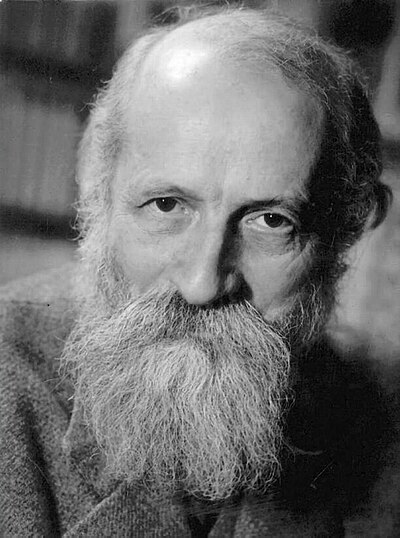
Martin Buber (1878–1965), the religious philosopher, advocated a binational solution in Palestine — a single state shared by Jews and Arabs on terms of equality. His organization, Brit Shalom (Covenant of Peace, founded 1925), attracted a small but distinguished group of intellectuals, including Judah Magnes (the first president of the Hebrew University), Gershom Scholem, and Ernst Simon. The binational vision was rejected by mainstream Zionism and by Arab nationalists alike, but it represents an important strand of the movement's moral and political thought.
Anti-Zionist Voices Within Judaism Debated
Zionism was far from universally embraced by Jews. Opposition came from multiple directions:
Religious anti-Zionism: Ultra-Orthodox rabbis, particularly in Hungary and Poland, condemned Zionism as a rebellion against God's decree of exile. The Satmar Rebbe, Joel Teitelbaum, articulated the most systematic theological opposition in his work VaYoel Moshe (1961), arguing that the establishment of a Jewish state before the messianic age was a violation of the "Three Oaths" described in the Talmud (Ketubot 111a) — that Jews would not ascend to the Land of Israel "by force," would not rebel against the nations, and that the nations would not oppress Israel "excessively." The Neturei Karta movement continues this tradition of theological anti-Zionism.
Reform anti-Zionism: Early American Reform Judaism, as expressed in the Pittsburgh Platform of 1885, explicitly rejected Jewish nationalism. The American Council for Judaism, founded in 1942, maintained this position even as mainstream Reform Judaism shifted toward support for a Jewish state.
Socialist anti-Zionism: The Bund and other Jewish socialist movements argued that the solution to Jewish oppression lay in revolutionary transformation of existing societies, not in territorial nationalism. Bundist leader Vladimir Medem's concept of neutralism — neither for nor against emigration to Palestine — represented a middle position, but the Bund's essential argument was that Jewish destiny should be worked out in the diaspora.
These dissenting voices were ultimately marginalized by the catastrophe of the Holocaust, which seemed to validate Herzl's central argument that Jews without sovereignty were Jews without security. But the questions they raised — about the relationship between Judaism and political power, about the ethics of nationalism, about the rights of other peoples in a shared land — remain vital and unresolved.
Locations in This Chapter
Loading map...