Part 3: Kingdoms · c. 1020–930 BCE
9.United Monarchy
Tel Dan Stele, First Temple, minimalist/maximalist debate
17 min read
The United Monarchy
A Kingdom Remembered, a Kingdom Debated
No period in Israelite history is more celebrated in tradition --- or more fiercely contested in scholarship --- than the United Monarchy of Saul, David, and Solomon. The biblical narrative presents a golden age: a shepherd boy who slew a giant and became king, a warrior-poet who united the tribes, and a wise ruler who built a magnificent temple. The archaeological record, by contrast, is frustratingly sparse, and what it reveals has ignited one of the most consequential debates in modern biblical studies.
The Biblical Narrative
TraditionThe story begins with the people's demand for a king. According to 1 Samuel 8, the elders of Israel come to the aging prophet Samuel at Ramah and say, "Appoint for us a king to judge us, like all the nations." Samuel is displeased, and God warns through him that a king will conscript their sons, take their daughters, confiscate their fields, and levy taxes. Nevertheless, God instructs Samuel to anoint Saul, son of Kish, of the tribe of Benjamin, as the first king of Israel.
Saul's reign is presented as a troubled one. He wins early military victories against the Ammonites and Philistines but repeatedly disobeys divine commands --- failing to wait for Samuel's sacrifice, sparing the Amalekite king Agag and the best livestock against God's orders. The Spirit of the Lord departs from Saul, and an "evil spirit from the Lord" torments him. Samuel secretly anoints the young David, son of Jesse of Bethlehem, as Saul's replacement.
Tradition
David's rise is epic in scope: the slaying of Goliath, his friendship with Jonathan, his years as a fugitive in the Judean wilderness, his service as a mercenary for the Philistine king Achish of Gath. 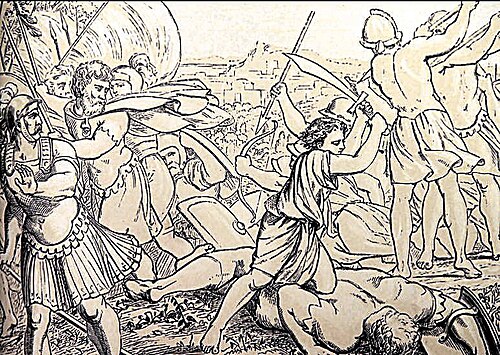
After Saul and Jonathan die in battle against the Philistines on Mount Gilboa, David becomes king first of Judah (at Hebron, for seven and a half years) and then of all Israel. He conquers Jerusalem from the Jebusites, making it his capital --- a brilliant political move, as the city lay on the border between the northern and southern tribes and had no prior tribal association.
David brings the Ark of the Covenant to Jerusalem, dances before it "with all his might," and expresses his desire to build a permanent temple. Through the prophet Nathan, God declines the offer but makes a covenant: David's dynasty will endure forever. "Your house and your kingdom shall be made sure forever before me; your throne shall be established forever" (2 Samuel 7:16).
Tradition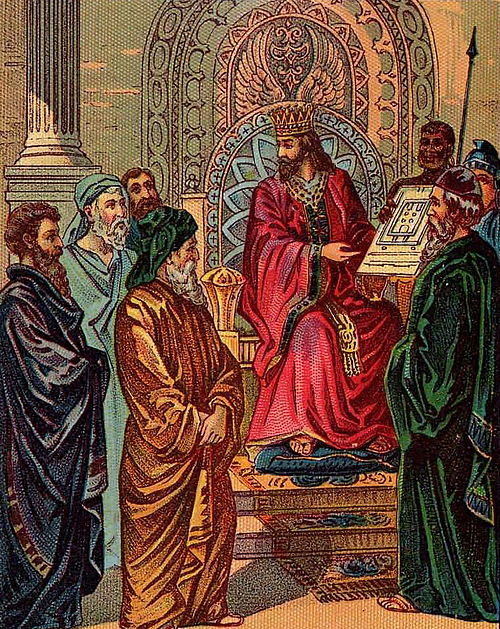
Solomon, David's son by Bathsheba, succeeds his father after a power struggle with his half-brother Adonijah. His reign is presented as Israel's zenith. He builds the First Temple in Jerusalem over seven years, a structure described in exquisite detail in 1 Kings 6--7: cedar from Lebanon, gold overlay, two bronze pillars named Jachin and Boaz, the Holy of Holies housing the Ark. He builds a royal palace even larger than the temple, fortifies cities including Hazor, Megiddo, and Gezer (1 Kings 9:15), establishes a fleet at Ezion-geber on the Red Sea, and trades with distant lands.
The Queen of Sheba visits, bearing gold, spices, and precious stones. Solomon composes 3,000 proverbs and 1,005 songs. His wisdom is legendary: "And God gave Solomon wisdom and understanding beyond measure, and breadth of mind like the sand on the seashore" (1 Kings 4:29).
But Solomon also sins. He accumulates 700 wives and 300 concubines, many of them foreign women who turn his heart toward other gods. He builds high places for Chemosh of Moab and Molech of Ammon. God declares that the kingdom will be torn from his son, leaving only one tribe for the sake of David. When Solomon dies, the kingdom splits.
The Tel Dan Stele: "House of David"
VerifiedIn July 1993, surveyor Gila Cook, working with archaeologist Avraham Biran at Tel Dan in northern Israel, noticed an unusual basalt stone protruding from a wall. When extracted and cleaned, it proved to be a fragment of a monumental inscription in Aramaic, dating to the mid-ninth century BCE (approximately 840 BCE). A second and third fragment were found the following year.
The inscription, now displayed at the Israel Museum in Jerusalem, was erected by an Aramean king --- most likely Hazael of Damascus --- and commemorates military victories over Israel and Judah. The critical phrase appears in line 9: bytdwd --- "House of David" (beit David).
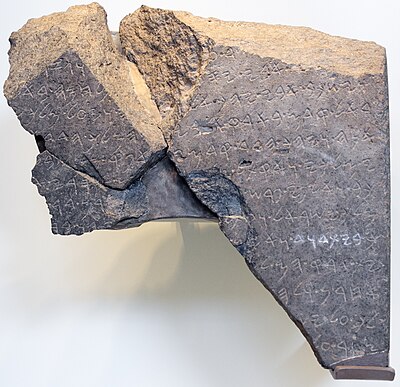
This was the first extrabiblical reference to David ever discovered. Before 1993, no inscription, no document, no artifact from the ancient world mentioned David. The minimalist school, which had argued that David was a literary invention --- a mythical founder figure comparable to King Arthur --- was dealt a significant blow. If an Aramean king in the ninth century referred to the Judahite dynasty as the "House of David," then David was remembered as a historical founder of that dynasty within roughly 150 years of his supposed reign.
DebatedNot everyone accepted the reading without challenge. Philip Davies, a leading minimalist scholar, initially suggested that bytdwd might not mean "House of David" at all but could be a place name or a divine epithet. Niels Peter Lemche and Thomas Thompson also raised objections. However, the reading has been accepted by the vast majority of epigraphers and historians, and subsequent studies have confirmed the standard interpretation. The Mesha Stele (see Chapter 10) may contain a similar reference to the "House of David" in a damaged line, though this reading remains more disputed.
Khirbet Qeiyafa: A Fortified City in David's Time?
VerifiedIn 2007, Yosef Garfinkel of the Hebrew University of Jerusalem began excavating Khirbet Qeiyafa, a fortified site overlooking the Elah Valley --- the very valley where, according to 1 Samuel 17, David fought Goliath. The site yielded remarkable finds.
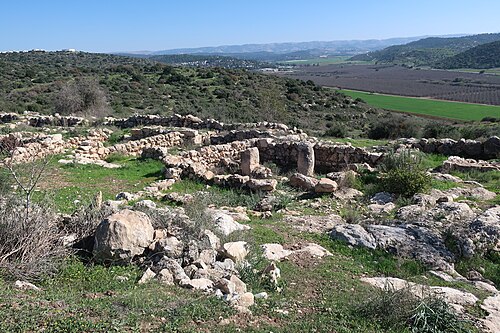
Khirbet Qeiyafa was a heavily fortified settlement, surrounded by a massive casemate wall with two gates (unusual for a site of this period --- its ancient name may be Shaaraim, meaning "two gates," mentioned in 1 Samuel 17:52). Radiocarbon dating of olive pits from the destruction layer placed the site firmly in the late eleventh to early tenth century BCE --- the period traditionally assigned to David's reign.
Verified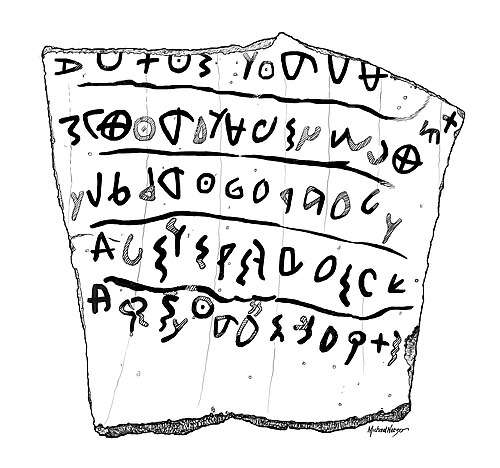
The site yielded the oldest known Hebrew inscription --- the Qeiyafa Ostracon, a five-line text on a pottery sherd written in proto-Canaanite script. Though the reading is debated, several scholars have identified words meaning "judge," "slave," "king," and references to caring for the widow and orphan --- themes reminiscent of biblical social legislation.
Garfinkel argued that Qeiyafa was a Judahite administrative center, evidence that a centralized state existed in Judah already in David's time. The site's sophisticated fortifications, standardized planning, and administrative artifacts (including model shrines that, notably, contained no human or divine figurines) suggested to him a polity far more organized than a mere chieftainship.
DebatedFinkelstein and others challenged this interpretation. Finkelstein suggested the site might be Canaanite or even Philistine rather than Judahite, or that its dating should be lowered slightly. Nadav Na'aman proposed it was a site of the Gibeonite polity. The debate over Qeiyafa became a proxy war for the larger minimalist-maximalist controversy: what kind of political entity existed in the Judean hills in the tenth century BCE?
The Minimalist-Maximalist Debate
DebatedThe terms "minimalist" and "maximalist" are somewhat polemical, and most scholars reject the labels for themselves, but they capture a genuine fault line in the field.
The Minimalist Position: Scholars such as Israel Finkelstein, Philip Davies, Niels Peter Lemche, Thomas Thompson, and Keith Whitelam argue that the United Monarchy, as described in the Bible, is a literary construction of later periods --- the late monarchic era or even the Persian period. In their view, tenth-century Jerusalem was a small highland village, not the capital of a significant kingdom. David and Solomon may have existed as local chieftains, but the grand empire described in 1 Kings --- stretching "from the river of Egypt to the great river, the river Euphrates" (1 Kings 4:21) --- is a retrojection of later Judahite aspirations.
Finkelstein's "Low Chronology," proposed in the 1990s, was central to this argument. By lowering the dating of certain pottery types and architectural features by approximately 75 to 100 years, Finkelstein reassigned the monumental gates and palaces at Megiddo, Hazor, and Gezer --- traditionally attributed to Solomon based on 1 Kings 9:15 --- to the time of the Omride dynasty in the ninth century. If the monumental architecture belonged to the Omrides, not to Solomon, then the archaeological case for a powerful Solomonic kingdom evaporated.
DebatedThe Maximalist Position: Scholars such as Amihai Mazar, William Dever, and Yosef Garfinkel argue that the archaeological evidence, while not confirming every detail of the biblical narrative, is consistent with a significant polity based in Jerusalem in the tenth century. Mazar proposed a "Modified Conventional Chronology" that splits the difference, assigning some monumental architecture to the Solomonic period and some to later periods.
Eilat Mazar (Amihai's niece, d. 2021) conducted controversial excavations in the City of David, claiming to have found the remains of David's palace --- a Large Stone Structure that she dated to the tenth century. Critics argued the structure was later or that its dating was uncertain. The debate was intensified by the politically charged nature of excavations in East Jerusalem.
Amihai Mazar, excavating at Beth-shean, demonstrated that the transition from the Bronze Age to the Iron Age was more complex than a single chronological shift, and his work at Tel Rehov produced a sequence of radiocarbon dates that challenged Finkelstein's Low Chronology. The debate is increasingly being resolved through radiocarbon dating rather than pottery typology alone, though results have not been entirely conclusive.
The First Temple: Text Without Stones
TraditionThe First Temple, or Solomon's Temple, is described in extraordinary architectural detail in 1 Kings 6--7 and 2 Chronicles 3--4. It was a long-room temple oriented east to west, with three sections: the ulam (porch or vestibule), the hekal (main hall or Holy Place), and the devir (inner sanctum or Holy of Holies). The dimensions given are 60 cubits long, 20 cubits wide, and 30 cubits high (roughly 90 by 30 by 45 feet). Two freestanding bronze pillars, Jachin and Boaz, flanked the entrance. The walls were lined with cedar from Lebanon, carved with cherubim, palm trees, and open flowers, and overlaid with gold. In the Holy of Holies stood the Ark of the Covenant, overshadowed by two cherubim of olive wood, each ten cubits tall, their wings spanning the width of the room.
Verified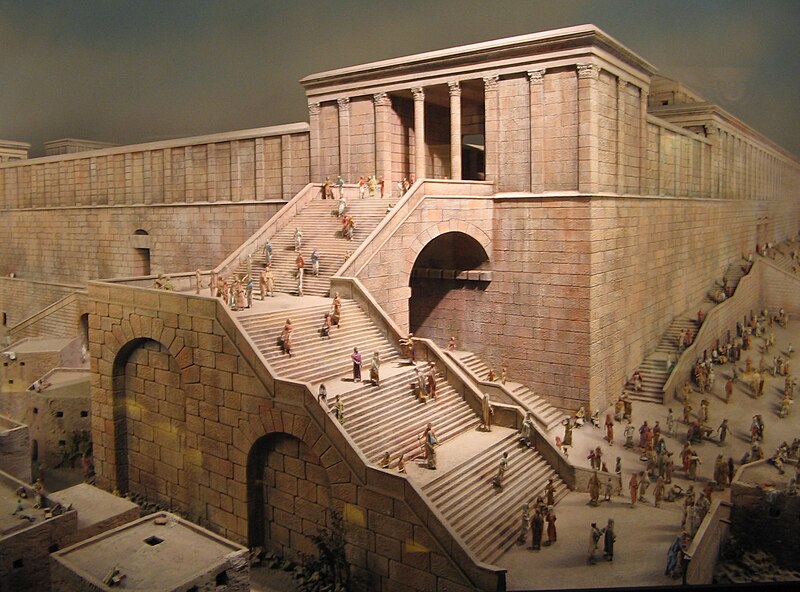
No archaeological remains of the First Temple have been found. The Temple Mount (Haram al-Sharif) in Jerusalem, where the temple stood, has never been systematically excavated due to its extraordinary religious and political sensitivity --- it is sacred to Judaism, Christianity, and Islam. The Dome of the Rock and al-Aqsa Mosque stand on the platform today.
However, the temple's described plan is not architecturally implausible. Parallels exist in Late Bronze and Iron Age temples elsewhere in the Levant: the Ain Dara temple in Syria (remarkably similar in plan and decoration, including giant footprints at the entrance), temples at Tell Tayinat, and the earlier temple at Aleppo. The tripartite long-room plan was a well-known architectural type in the region. The cherubim flanking the Ark find parallels in sphinx thrones from Phoenician and Syrian art.
DebatedThe Solomonic temple as described in 1 Kings may include elements from different periods. Some scholars suggest that the description reflects a later temple --- perhaps the pre-exilic temple as it existed in the seventh century, after centuries of renovation --- retrojected to Solomon's time. Others argue that the level of specific detail (measurements, materials, techniques) suggests genuine architectural memory. The truth may be that the description preserves a core of historical memory overlaid with idealization and anachronism.
The Gezer Calendar
Verified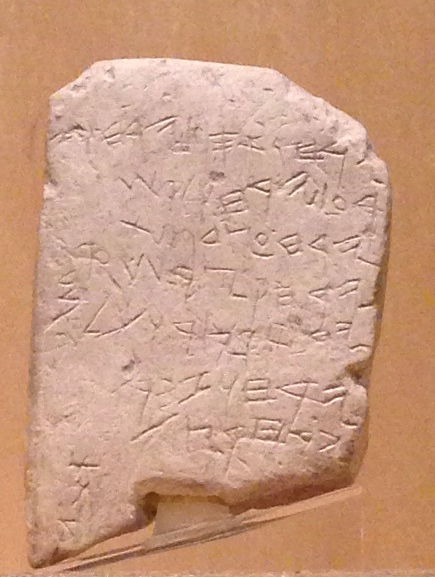
Discovered in 1908 by R.A.S. Macalister at Gezer, this small limestone tablet, now in the Istanbul Archaeological Museum, dates to approximately the tenth century BCE. It lists agricultural activities by month --- sowing, harvest, pruning, summer fruit --- and is one of the oldest known Hebrew inscriptions (though whether the language is Hebrew, Phoenician, or a local Canaanite dialect is debated).
The Gezer Calendar is significant less for its content than for what it implies: by the tenth century, someone at Gezer was literate enough to produce a written text. Combined with the Qeiyafa Ostracon, it suggests that writing was practiced in the region during the period traditionally assigned to the United Monarchy, though the extent of literacy remains debated.
Copper Mining at Timna and Faynan
VerifiedRecent excavations at Timna in the Aravah Valley (southern Israel/Jordan border) and at Khirbet en-Nahas in Faynan (Jordan), led by Thomas Levy of UC San Diego and Erez Ben-Yosef of Tel Aviv University, have revealed large-scale copper smelting operations dating to the tenth century BCE. Radiocarbon dating places peak production precisely in the period of the United Monarchy.
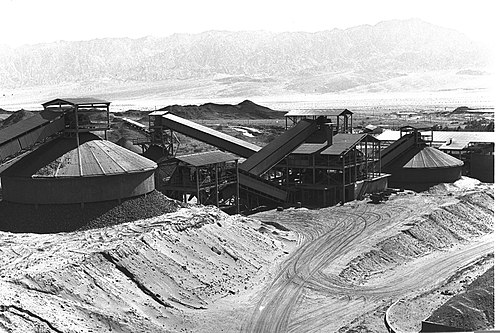
Ben-Yosef's excavations at Timna's "Slave Hill" (Site 34) uncovered evidence of sophisticated metallurgical technology and a well-organized labor force --- including high-quality textiles, food remains including fish from the Mediterranean, and evidence of long-distance trade. The scale of production suggests centralized organization.
DebatedWhether this copper production was controlled by a Judahite/Israelite state, by the Edomites, by Egyptian interests, or by some other entity remains debated. Ben-Yosef has argued that the Timna evidence supports the existence of a complex, organized polity in the region during the tenth century --- even if that polity left few monumental remains in the highlands. His concept of a "nomadic kingdom" challenges the assumption that political complexity requires monumental architecture, suggesting that David and Solomon could have ruled a significant state that was largely invisible in the traditional archaeological record.
From Tribal Confederation to Statehood
DebatedWhatever the scale of the United Monarchy, the transition from the decentralized tribal society of the Judges period to some form of centralized authority is a genuine historical phenomenon. The question is not whether it happened but when and how quickly.
The impetus for state formation is often attributed to external military pressure, particularly from the Philistines. The Philistines, part of the Sea Peoples who settled the southern coastal plain around 1175 BCE, possessed superior military technology, including iron weapons and chariots. The battle of Ebenezer, in which the Philistines captured the Ark of the Covenant (1 Samuel 4), and the later battle of Gilboa, where Saul died, represent the existential threat that made centralized leadership necessary.
VerifiedPhilistine sites such as Ekron (Tel Miqne), Ashkelon, and Gath (Tell es-Safi) have been extensively excavated, revealing a prosperous, urbanized culture with strong Aegean connections. The inscription at Ekron, discovered in 1996, names five rulers of the city --- confirming the biblical tradition of Philistine city-state organization. Gath, excavated by Aren Maeir, has yielded a potsherd with two proto-Semitic names that may be linguistically related to "Goliath," though this is not a reference to the biblical figure.
The material culture gap between the Philistine coastal cities and the Israelite highland villages in the eleventh-to-tenth centuries is dramatic: the former are urban, wealthy, and cosmopolitan; the latter are rural, modest, and insular. The eventual Israelite victory over the Philistines --- whether under Saul, David, or their successors --- represents a remarkable reversal.
Jerusalem in the Tenth Century
DebatedThe size and significance of tenth-century Jerusalem is perhaps the single most contentious question in the debate. Minimalists argue that Jerusalem in David and Solomon's time was a small, unfortified village of perhaps 1,000 to 2,000 inhabitants --- hardly the capital of a great kingdom. They point to the limited archaeological evidence: excavations in the City of David have revealed relatively modest structures, and no clear tenth-century fortification wall has been universally accepted.
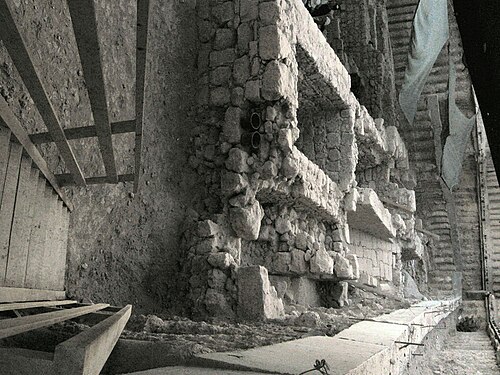
Maximalists counter that Jerusalem has been continuously occupied for over 3,000 years, and later construction (particularly Herod's massive expansion of the Temple Mount) likely destroyed much of the earlier evidence. They point to the stepped stone structure in the City of David --- a massive terraced foundation --- as evidence of monumental construction in the pre-monarchic or early monarchic period. Eilat Mazar's Large Stone Structure, built atop the stepped stone structure, has been claimed as David's palace, though this identification is far from settled.
VerifiedWhat is archaeologically clear is that Jerusalem grew dramatically in the eighth and seventh centuries BCE, reaching perhaps 25,000 inhabitants by the time of Hezekiah. Whether this growth represented an expansion from an already-significant tenth-century base or a transformation from a tiny village to a major city is the heart of the debate.
Conclusion
The United Monarchy remains an era where faith and evidence, memory and archaeology, do not yet speak with one voice. The Tel Dan Stele proves that David was remembered as the founder of the Judahite dynasty. Khirbet Qeiyafa demonstrates that a fortified settlement existed in the Elah Valley during the relevant period. Timna shows sophisticated copper production under centralized organization. But the grand Solomonic empire of the biblical text --- with its temple of gold, its fleet of ships, and its legendary wisdom --- remains elusive in the ground.
Perhaps the most honest summary is that of Amihai Mazar: "The pendulum has swung too far in both directions." The biblical account is not straightforward history, but neither is it pure fiction. Somewhere between the scrolls and the stones lies a historical David --- smaller than legend, larger than the skeptics allow --- who founded a dynasty that would shape the history of the world.
Locations in This Chapter
Loading map...